
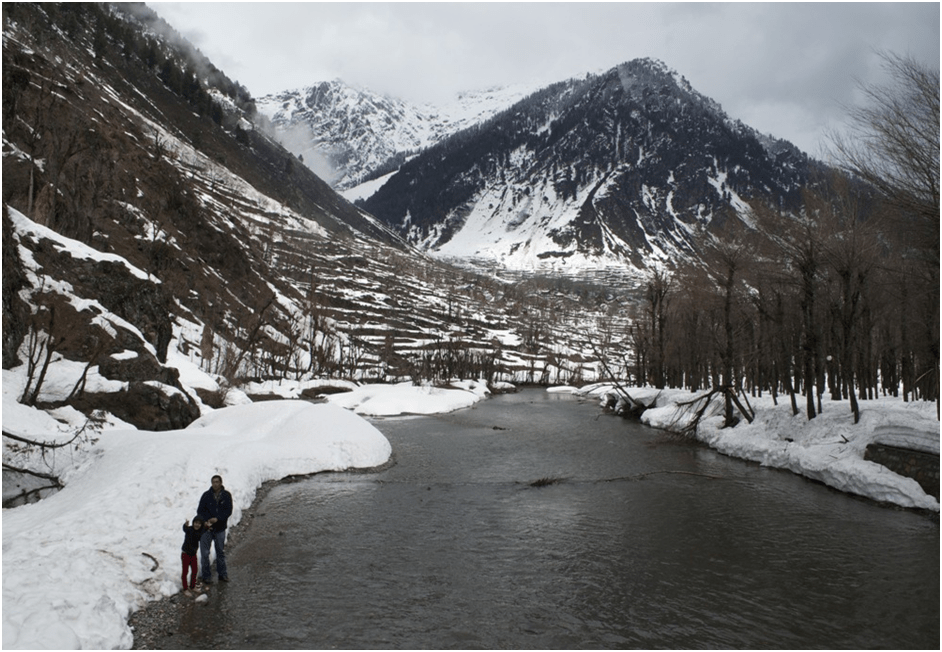
**On the way to Pahalgam**
After our long journey to the Vaishno Devi shrine, resting was our top priority. We enjoyed chatting about our experiences over lots of pakoras (vegetables fried in chickpea flour) and tea.
Our next host for the Kashmir tour was Riaz, who had already arrived with the driver, Gulzar. They travelled from Srinagar to greet us, a wonderful gesture that reflected the age-old Indian tradition of hospitality, “Atithi Devo Bhava”, meaning that the guest is God or should be treated like God.
We went to bed early to prepare for our trip from Katra to Pahalgam. We planned to leave by 5:30 AM to reach Pahalgam by 4 PM. However, our fate had other ideas. I woke up at 4:00 AM and looked out the window as dawn broke. The twinkling lights on the path to the Vaishno Devi Shrine from our room window resembled a string of pearls, filling me with a sense of peace and reverence. The serene atmosphere, the distant sound of temple bells, and the sight of devotees making their way to the shrine in the early morning filled me with a sense of peace and reverence. I absorbed the spiritual energy of the place, with the cool mountain breeze carrying the scents of pine and incense.
“Get ready,” Arpan reminded us.
Our journey to Pahalgam, a picturesque town in the Anantnag district of Jammu and Kashmir, began before dawn. The air was charged with anticipation as we left the city behind and ventured into the heart of the Himalayas. The cloudy skies added an element of mystery to the start of our adventure, igniting excitement in all of us. It was a true adventure, and we were eager to see what lay ahead.
“A sweet breeze is blowing. It may be raining somewhere,” my mother remarked, her happiness tinged with worry about the rain as we ascended the mountain, a concern that resonated with all of us.
The journey through the dense pine trees, with their branches swaying gently in the breeze, and the breathtaking vistas of the iconic Snowy Greater Himalayas were both fascinating and inspiring. The snow-capped peaks, lush green valleys, and crystal-clear streams we passed were a sight to behold. The brilliant contrast of the pristine white snow against the greenery of the valleys was a visual treat. I was overwhelmed by the sheer beauty of nature, and I couldn’t help but feel a sense of awe and wonder. Everyone on the bus exclaimed, “Wow!” Driving along the National Highway, we noticed some dessert shops on both sides of a place called Kud, which sparked our interest and our craving for sweets. Bapi bought Patissa and Chocolate Barfi (Indian sweets), and everyone eagerly reached for a bite. The taste was heavenly, and I wished we could have bought more.

Sweet shop at Kud
NH 1A had traffic restrictions, and our vehicle bound for Pahalgam needed to leave Udhampur by 12:30 PM. Since we had plenty of time, we stopped at Patnitop in the Udhampur district. This hill station, cradled in a serene plateau, offered a peaceful escape. The tranquillity of this place was so soothing; it felt like a gentle massage for the soul. Distant snow-capped mountains sparkled like jewels in a crown, enriching the peaceful panorama. I couldn’t resist the opportunity to soak in this serenity. We reluctantly continued our journey, promising to return for a more extended, leisurely visit.
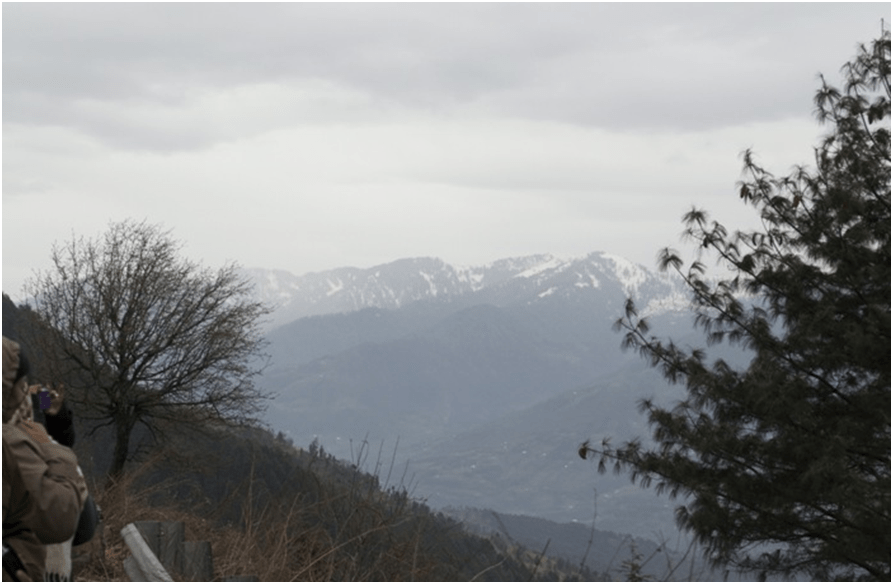
Patnitop view
In Karmeel, we caught a glimpse of the famous Chenab River on our right. I was thrilled to see her aqua blue, sometimes whitish path below while we climbed the gorge. The Chenab, originating from Bara Lacha Pass in Himachal Pradesh, is formed by the upper tributary Chandra and the southern tributary Bhaga, which meet in Tandi and create the Chandrabhaga or Chenab. I was excited to find that we were following her flow. However, the bus window hindered my full appreciation of her beauty. After crossing the bridge near Picketi, the Chenab appeared on our left, only to recede after a few kilometres, leaving us longing for more.
The day began under a cloudy sky, but the sun peeked out intermittently throughout our journey, often hiding behind a thick blanket of clouds. The rain started before we passed Karol Nallah, a broad tributary of the Chenab. From a distance, the Chenab seemed to engage in a captivating game of hide-and-seek with us, drawing closer and moving away. Finally, in Teli, she bid us farewell, flowing towards Punjab.
**Encountering a Landslide – a memorable experience**
The rain intensified, making driving challenging due to the heavy downpour and sharp, winding roads. In a small town called Sojmatna near Panchal, Gulzar announced, “That’s it; the bus won’t move anymore.” After crawling along slowly for a while, the bus came to a complete halt, and all the vehicles in front also stopped.
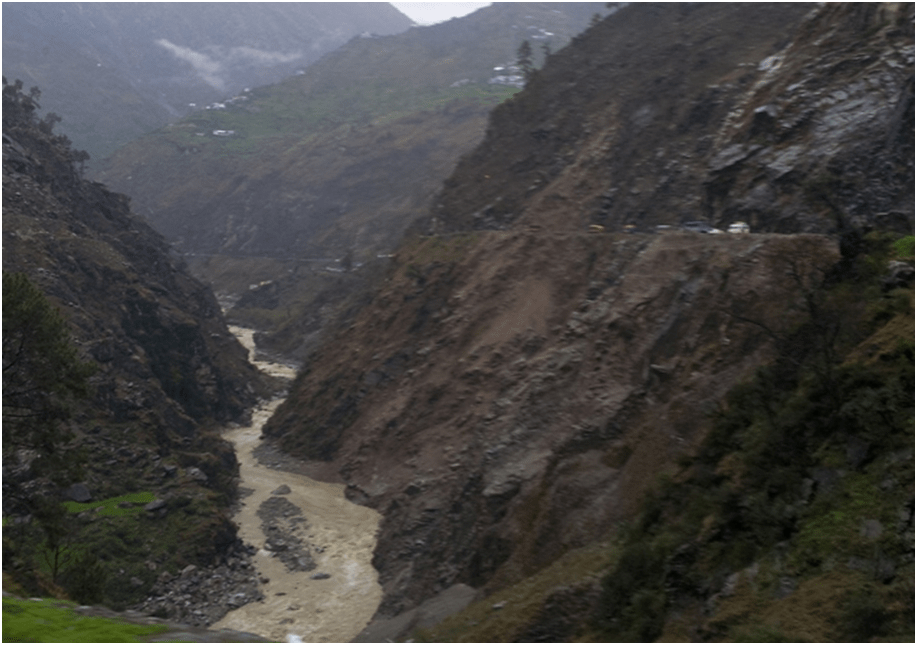
Breathtaking view of Chenab tributary from our bus window
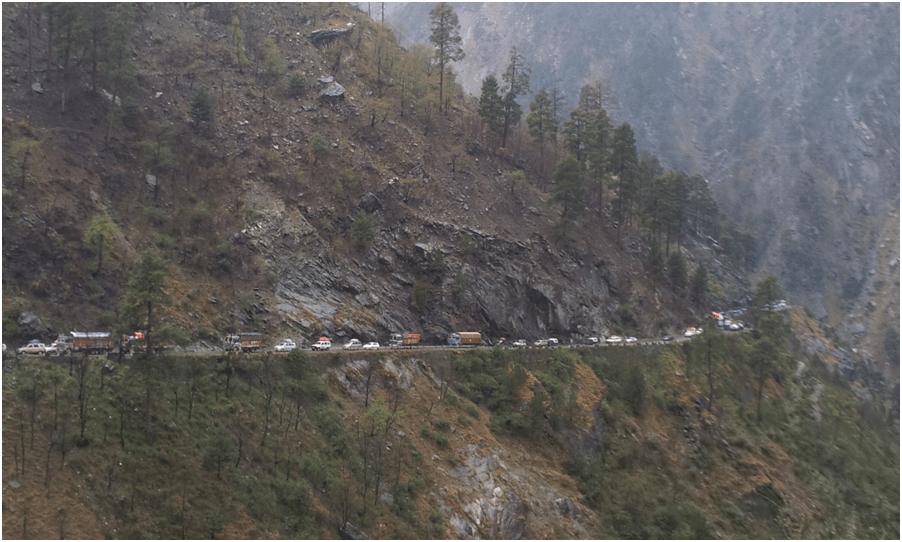
The vehicles were lined up, waiting for the road to be cleared.
“Breathtaking!” I peeped through the bus window to take in a terrifying yet equally awe-inspiring scene near the steep Chenab River gorge. Cars, buses, trucks, and military vehicles lined up on the narrow path of the steep canyon, with no fencing in between. It was genuinely scary! The mist from the river added to the eerie atmosphere.
A massive landslide caused by the heavy rainfall severely damaged the road, causing a chunk to fall into the gorge. The falling rocks blocked our way, giving everyone in our group a unique experience—their first encounter with a landslide!
“The rocks will be cleared when the rain stops. It may take several hours,” Riaz said, not exactly comforting. To make matters worse, it was still raining. We could see the gloomy sky above while the mountains around cast dark shadows in the gorge. “Navigating through the terrain would be challenging later,” Lekha was concerned. So were we all. As we sat on the bus, anxiety and a hint of fear lingered, the uncertainty of our journey hanging over us like a thick fog.
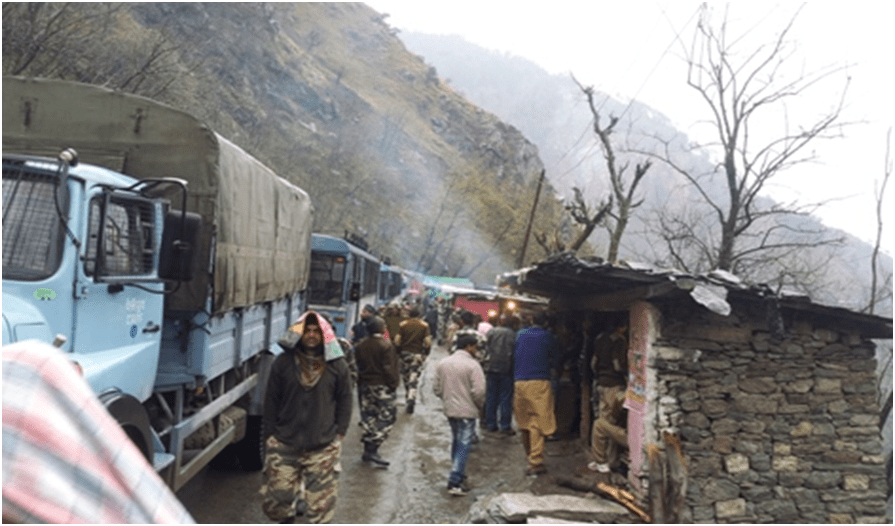
We are stuck
“Will we reach Pahalgam this evening?” Shreya asked, concerned, as she turned to Riaz, who seemed to have answers.
“Until the rain stops, the BRO (Border Road Organization) can’t get their machinery out to clear the road,” Riaz explained.
A mix of emotions—excitement, apprehension, and a hint of fear—coloured our experience. The thrill of the unknown, anticipation of what was to come, and slight unease of being in an unfamiliar place all contributed to this emotional rollercoaster. There were no toilets in sight, and the ladies grew anxious.
As the rain continued to pour, we found ourselves confined in the bus, unable to venture out due to the rough and narrow terrain. However, this shared experience brought us closer together. I uplifted everyone’s spirits by playing music on my mobile phone and distributing snacks. The locals and military personnel, also affected by the slide, came out on the road in the rain to share their stories, creating a sense of camaraderie. The military personnel walked along the road to ensure that nobody crowded the narrow pathway unnecessarily.
All the people flocked to the only roadside shop selling sweet treats made from flour and sugar. Eating was the best option for some, as there was little to do. The shopkeeper probably made more money in one day than he would in an entire month. Even Arpan tasted some, but everyone else missed out.
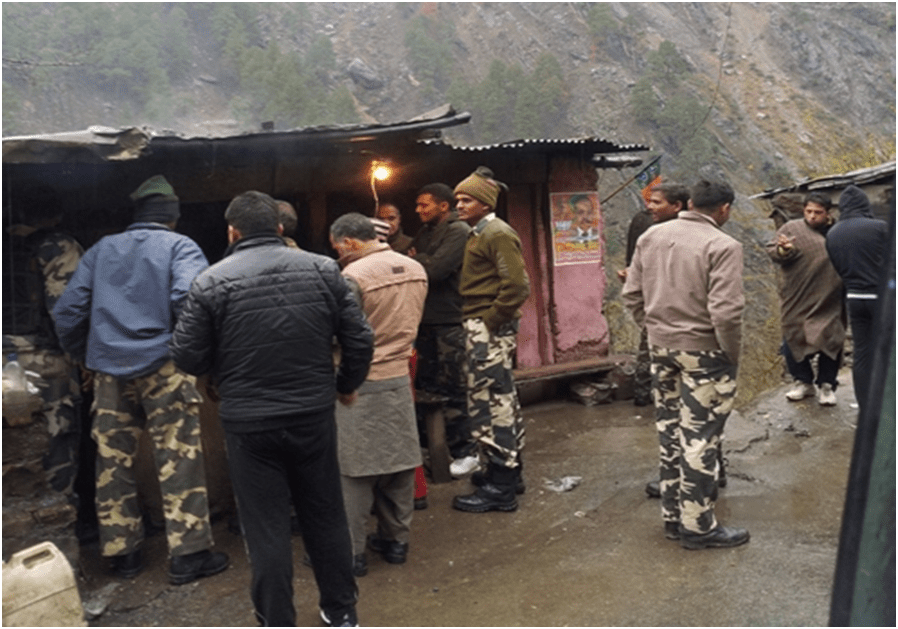
The landslide made this shopkeeper’s day
**Landslide cleared at last**
Everyone grew restless while waiting for the rain to stop. We set off from Katra at 5:30 AM, and by nearly 6 PM, the daylight was fading. Suddenly, people began running toward their cars as the Border Roads Organisation (BRO) cleared enough space for vehicles to navigate through a narrow, rough turn. The traffic started to move very slowly, but the rain continued to fall.
Further up the road, the scenery became unclear, but we could see the snow on both sides illuminated by the headlights. Throughout the ride, Gulzar joked about the “dilemma in Panchal,” which made the place popular among us. Whenever we encountered a problem, he would refer to ‘Panchal’. To be honest, I thoroughly enjoyed staying on the bus during the landslide and observing the movement of people around us, even though my fellow passengers had other ideas!
We all felt immensely relieved that no one, especially the ladies, had to deal with the inconvenience of finding a toilet during the nearly eight hours we spent at Panchal. Riaz and Gulzar, our guides and companions, were a constant source of encouragement. Their words, “We will go along Banihaal Pass through the Jawahar Tunnel soon, and then we won’t take much longer,” kept our spirits high.
As hunger pangs set in from missing our lunch, we stopped near Qazigund, where we were treated to world-famous Kashmiri kebabs. The aroma, the taste, the satisfaction—a culinary experience we all savoured and wished would last longer. The joy of discovering and indulging in the local cuisine added a delightful twist to our journey.
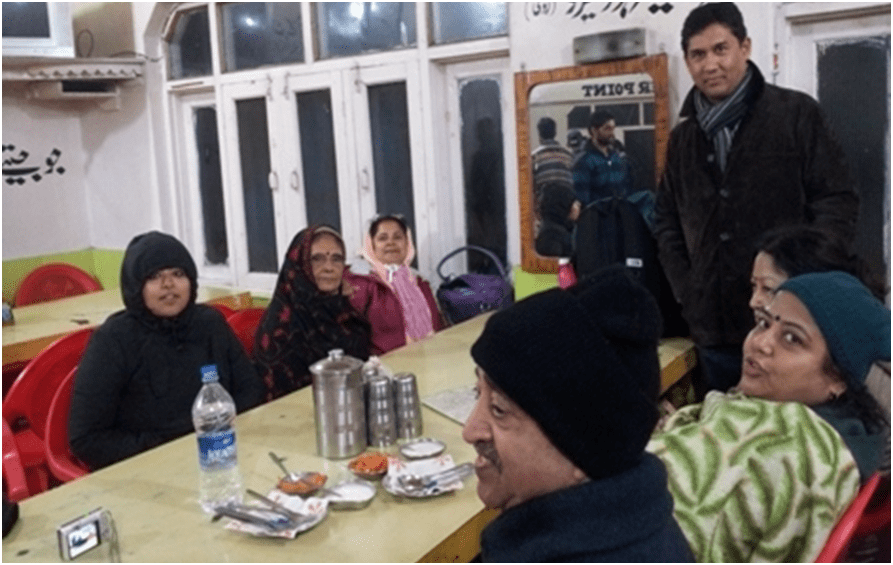
At last we had something to eat
**Entry to the Dreamland – Pahalgam**
The lights twinkled in the distant valley, and the snow-covered road around us felt like we were passing through a fairyland. After turning right at Anantnag toward Pahalgam, we noticed the Lidder River, a tributary of the Jhelum, flowing alongside us like a silver ribbon. Although it was dark and we couldn’t see clearly, we could hear the soothing sounds of the river. The unseasonal snow in Pahalgam looked like a pathway to heaven.
We checked into the log cabins of a hotel that had opened just two days ago after restoring the power and water supply. However, the service had not yet returned to normal. With temperatures hovering below freezing, we hurried to inspect the layers of blankets provided for us. They offered electric blankets, but frequent power outages rendered them largely ineffective. We were served a basic yet wholesome meal featuring local delicacies such as Kashmiri-style vegetable curry and paratha, which satisfied us all.
The water was icy, a reminder of the frigid temperatures outside, and with the lack of stable power, we had limited access to hot water. Shivering, I crawled into bed, my body aching from the day’s journey. Despite the discomfort, exhaustion quickly took over, and I fell into a deep, dreamless sleep.
**Snow-covered Pahalgam – a scene from a fairytale!**
In the morning, we peeked through the window and saw the snow blocking the reception area and blanketing everything around us. We stepped out onto the veranda, exclaiming, “Oh, splendid!” The breathtaking view that greeted us revealed a thick layer of snow that had transformed the landscape, including the narrow River Lidder, into a picturesque dreamland. The previous day’s worries about the landslide felt like a distant memory.
I was utterly entranced by the beauty of Pahalgam. Lost in the moment, I struggled to find the right words to express my joy. I stood there, spellbound, for what felt like an eternity until the click of Bapi’s camera brought me back to reality.
I thought, “I better take some photos as well.” The air was invigorating, filled with the fragrance of pine trees, while the river’s gentle murmur created a soothing melody. “Finesse! This is priceless!” Arpan and Bapi nodded in agreement. Lekha joined us in watching the spectacle, too.
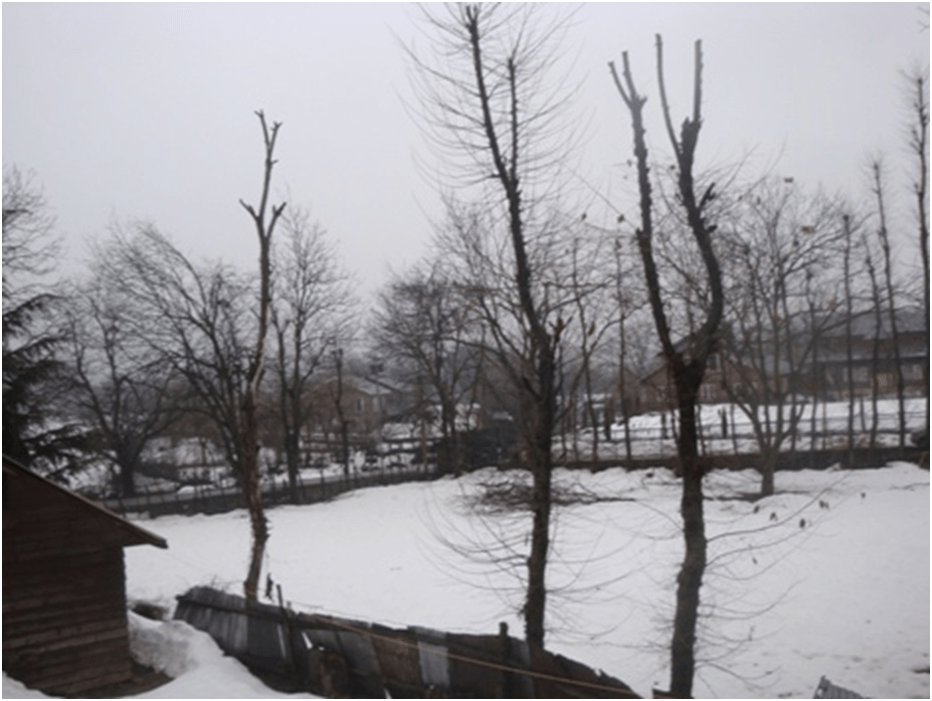
Snow blanketing around our hotel in Pahalgam
I realised I might never experience the beauty of snow in Pahalgam again. The snow was unseasonal, and we felt lucky to witness it. Pahalgam is famous for its lush green meadows and valleys. Standing there, captivated by the scenery, I made a silent promise to return to Pahalgam for its snow-covered charm and to experience its vibrant green beauty. The snow-covered landscape of Pahalgam inspired a sense of awe and wonder that I will always cherish.
**The Valley of the Shepherds:**
Pahalgam, a picturesque destination in Kashmir, has a rich history. Once a humble shepherd’s village, it has become a popular hill station. This transformation is reflected in the breathtaking views of fir-covered mountains and snow-capped peaks. The valley’s appeal is enhanced by its pine forests, healthy climate, and vast meadows, all nourished by the torrential flow of the River Lidder.
As Kashmir’s premier resort, Pahalgam is stunning even in summer, with maximum temperatures rarely exceeding 25 degrees Celsius. The nighttime temperatures are also mild, as it is located at a lower altitude than other famous hill stations like Gulmarg. A popular destination, Pahalgam is favoured for Bollywood film shoots and serves as the base camp for the famous religious trek, the ‘Amarnath Yatra.’ Devotees trek through challenging mountainous terrain to reach the natural stalagmite Shivling formation inside a cave, found at 12756 feet, before descending from 15000 feet.
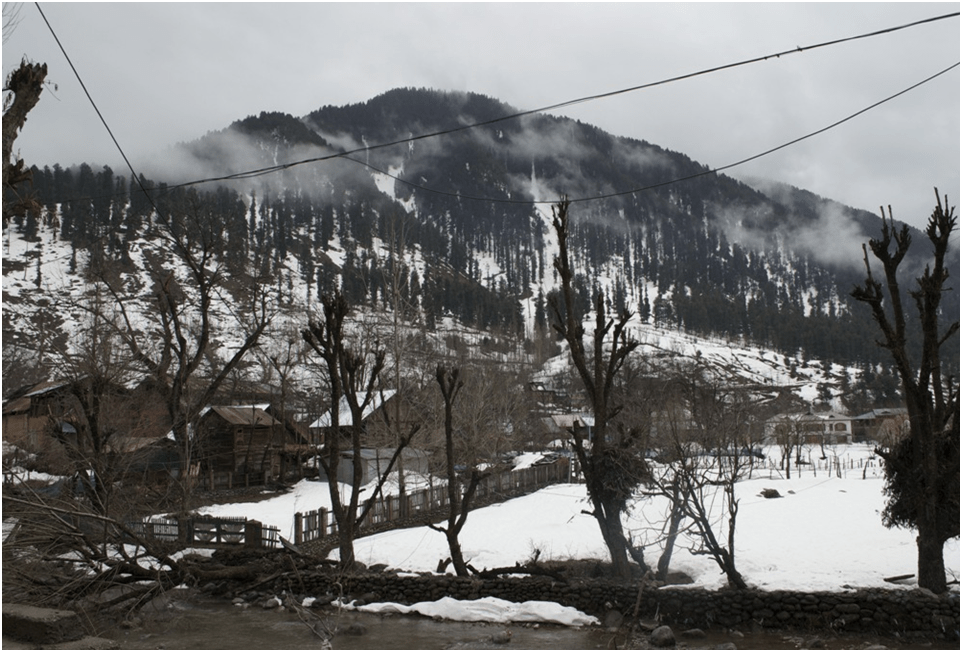
Snow covered beauty of Pahalgam
The cultural practices of the Kashmiri people are a unique and fascinating aspect of Pahalgam. To stay warm, it is truly captivating to see them carrying a Kangri (a pot filled with burning charcoal) underneath their traditional attire, the Phiran. Riaz followed this tradition, while Gulzar was the only Kashmiri wearing trousers and a jacket.
Our kitchen manager, Saba, treated us to a delightful breakfast that included an omelette over toasted bread, stuffed parathas, and bhaji (curried vegetables). His warm and friendly demeanour and culinary skills made our stay even more enjoyable. The other hotel staff members were equally pleasant and talented in the kitchen, and their cooking was a highlight of our trip.
**Mystical Valley views and Betab Valley**
Tourism is the primary source of income for most people living in this area. We hired a local 4WD for our sightseeing adventure. It was raining again, but the views we passed were stunning, with a mystical backdrop of mountains. The drivers demonstrated impressive skills, making way for oncoming vehicles and allowing rare overtaking opportunities. In some places, the roads were just wide enough for one large vehicle. Our first stop was a beautiful spot called Betab Valley.
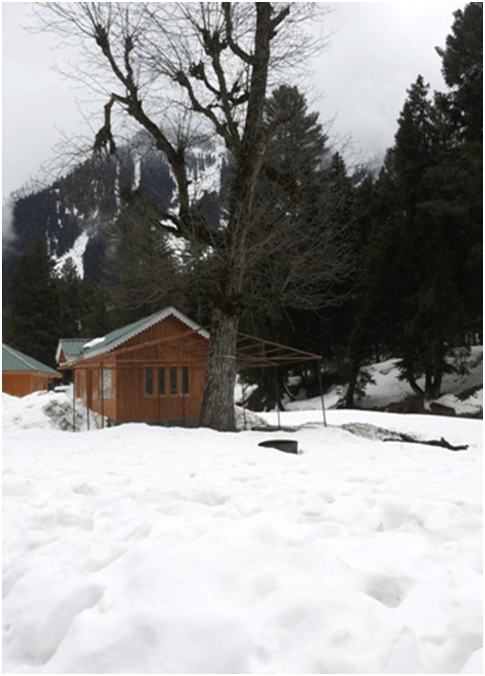
A lone cottage in Betab Valley
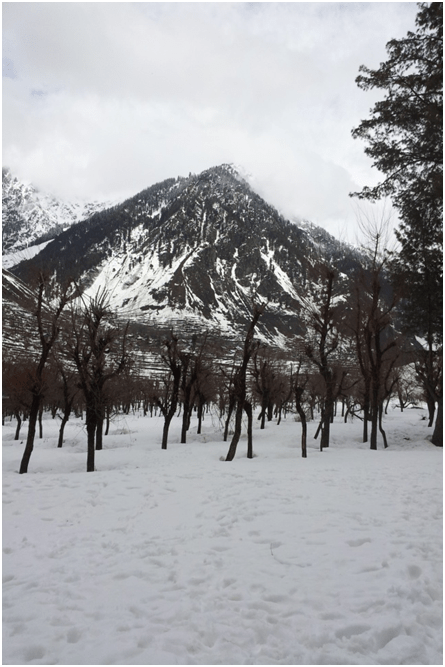
Betab Valley
We immediately fell in love with this place. It was the school holiday season, and there were many visitors, but the valley was large enough to accommodate everyone. With the sticks we had rented, we explored charming, quieter spots further inside, away from the crowds. The valley was blanketed in snow, and a small stream flowed beneath a quaint bridge. A lone, snow-covered cottage stood in this romantic getaway, surrounded by fir trees, allowing us to feel the silence of nature’s language.
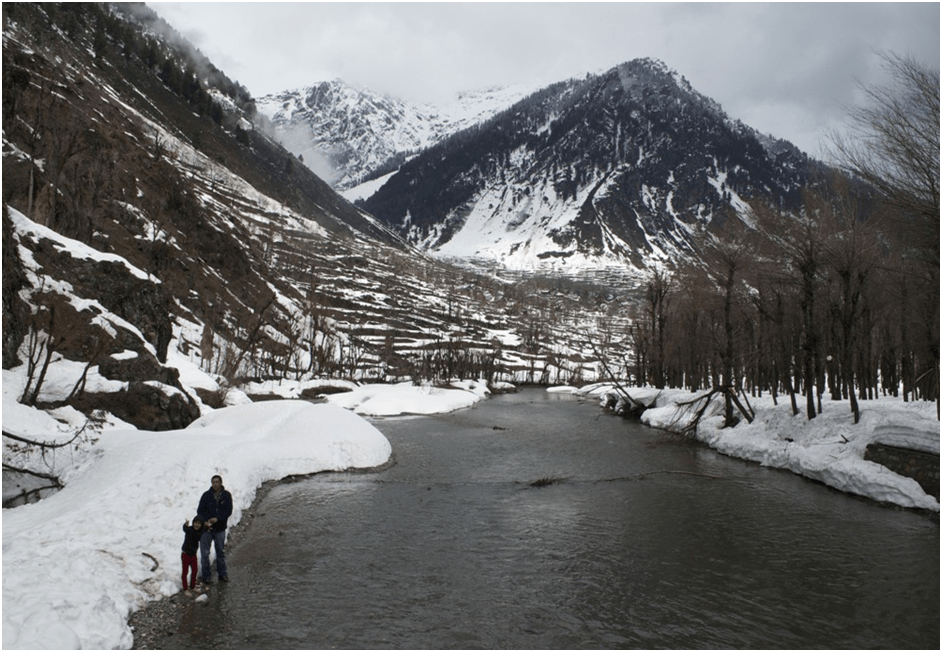
Stream running quietly through Betab Valley
Our enthusiastic and camera-happy guide, Firoz, took the camera from Arpan and began taking our photos, even directing us on the pose. We enjoyed his company and appreciated his warm hospitality. He entertained us with unique stories about the area, noting that it was made famous by a popular old Bollywood movie titled “Betab.” We were grateful to the Jammu and Kashmir Government for designating this place as a tourist spot, as it enables local residents to earn a living by guiding or selling local produce. The warm smiles and eagerness of the local people to help were a testament to the resilience of the human spirit, adding an authentic touch to our experience. We truly felt welcomed and appreciated, and their resilience in the face of socio-economic challenges was inspiring.
**The road to Aru Valley**
The road to Aru Valley was winding and very narrow. Aru Valley is a scenic village located 12 km from Pahalgam. The drive up to the valley was captivating, with the village nestled among the lush grasslands. Although the driver was quite experienced on these narrow roads, we felt a bit anxious, especially Rakhi. To make matters worse, it started raining again. She was seated on the side facing an abrupt gorge that dropped off sharply, and only a 30-centimetre border of snow separated the gorge from the road. Her face grew increasingly fearful as we climbed higher, and she began chanting prayers. I tried to comfort her, but the journey could have been more pleasant without the rain. We spotted loose rocks in some areas, and the possibility of landslides or falling debris loomed over us, so we decided to abandon our visit to Aru Valley. While Lekha and I were disappointed, everyone else agreed with the decision.
Arpan reminded us, “We’re travelling to Srinagar tomorrow, and we don’t have time to waste.” Our tour was time-sensitive, so we didn’t want to take any more chances and asked the driver to turn back.
But returning wasn’t straightforward. The road was wide enough for only one car, with a gorge on one side and an ice wall on the other. We had to drive a few kilometres uphill to find a broader spot to make a U-turn. Cars continued to come from the opposite direction, but our skilled driver managed to make a tight U-turn, taking us back.
After spending considerable time on the road, we returned to Pahalgam for lunch. We were hungry until we reached the shops, where my mother was enchanted by what she saw. She wanted to buy shawls, jackets, and saris for everyone. Once we entered the shops, we lost track of time.
“It’s nearly 3:30 PM,” Bapi reminded us. We were so absorbed in shopping that we overlooked lunch.
** Lidder River**
In the afternoon, only a few of us—enthusiastic individuals like me, Lekha, Arpan, and Bapi—ventured out for a walk along the bank of the narrow stream of the River Lidder, which flowed in front of the log cabins. Along the way, we encountered some locals and discovered where they lived. It was disheartening to see the poverty in the area. Despite wearing traditional Phiran to keep warm, the lively children played barefoot in the streets. Surprisingly, they didn’t feel the cold, while the older adults wore Phiran with Kangri (a traditional earthen pot for heating) underneath. This stark contrast in living conditions served as a poignant reminder of the socio-economic challenges faced by the region.
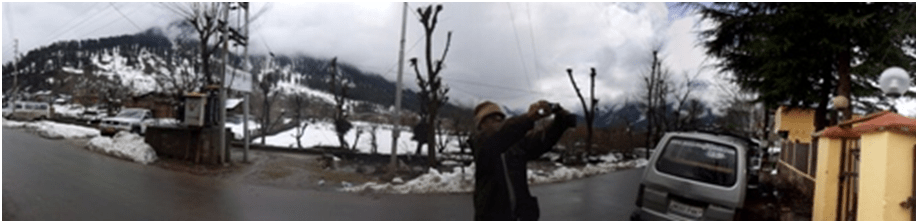
Tried to Capture a panoramic view in front of our hotel
One benefit of travelling in a group is that you’re never bored. Our evening was delightful, with Riaz and Saba joining us. We enjoyed delicious snacks and a wonderful time together. Since only a few people were staying at the hotel and service was still being restored, Saba had time to spend with us. He shared stories about his family and mentioned living in Aru Valley and commuting there weekly. Once a shepherd, he worked in the hotel to make a living. We had fun teasing one another and gained valuable insights into Kashmiri culture, the local people’s situation, and the government’s efforts to support them. The evening was informative and relaxing, just as I liked it. We truly appreciated their company and felt enriched by the experience.
 callofthefar.com
Leave a Comment