
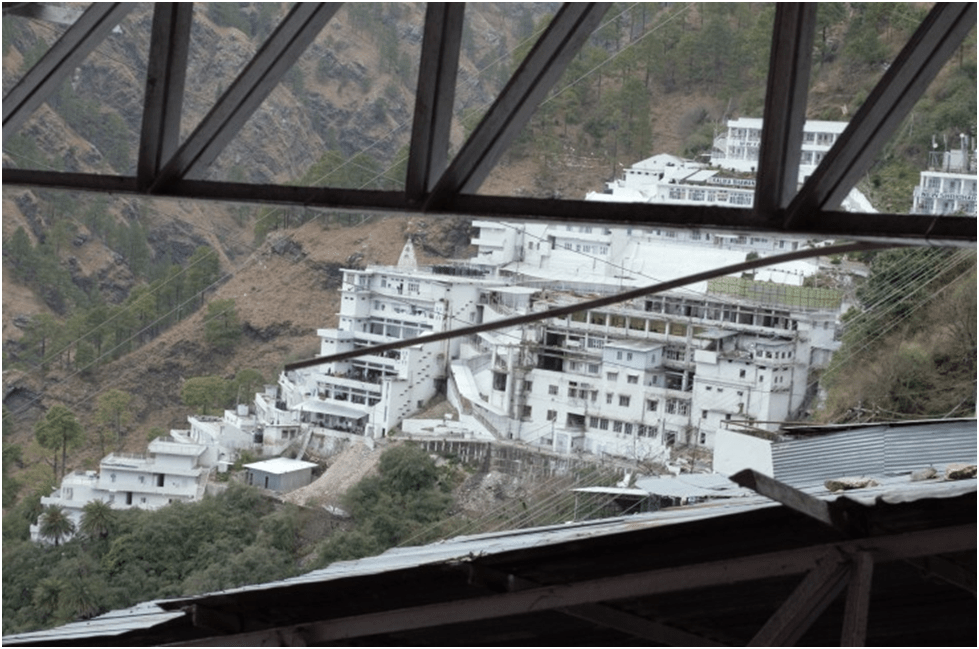
**Road to Vaishno Devi**
We met Bapi, Rakhi, and Shreya and decided to travel to Katra. The company we hired the car from was difficult. I suggest clarifying everything before hiring a car. Sometimes, they say yes to everything and then change their mind later.
Katra is approximately 47 km from Jammu and takes around 2 hours to reach. The journey through the winding road, with swaying pine trees on both sides, was a sight, and the gentle breeze added to the feel-good charm. The magnificent view of the Tawi River and mountains that welcomed us as we left Jammu was nothing short of awe-inspiring. Everyone in the car was quiet, soaking in the journey. We couldn’t take our eyes off the stunning landscape until our vehicle came to a stop at a checkpoint. The soldiers who handled security inspired us. They chanted “Jay Mata Di” (Hail/Victory to Mother Goddess), a special ode to Vaishno Devi, and wished us luck. We checked in at a hotel in Ban Ganga, located at an altitude of 2,800 ft near Katra, a little closer to the shrine. My mother, Maya, my cousin Bapi, his wife, Rakhi and daughter, Shreya, my husband, Arpan, and I were looking forward to starting our journey around 8 PM to avoid the heat. My sister-in-law, Rekha, and Amit were fortunate to have already visited the shrine.
In the afternoon, we checked into a hotel at Ban Ganga, the entry point for the Vaishno Devi Journey. After a few hours of rest and a light dinner, we were excited and ready to hike up.
My mother, Maya, was excited to see her “Palanquin” arrive. This was the moment of truth we were all waiting for. We were all geared up and excited to walk uphill 14 km to the Vaishno Devi Shrine. We set out in the evening.
My mother was delighted to see her “Palanquin” **but a bit sceptical, “Sure they won’t drop me?”
“Relax, Aunty; they are experts who will take good care of you”, Bapi assured.
Helicopter service, Mules/Pony/Horse riding, and Palanquins were available to hire. Still, we chose to walk to experience the feeling of walking together with the other pilgrims on this sacred journey. We wanted to achieve spiritual fulfilment while enjoying the scenery around us. The decision to walk was not just a physical choice but a spiritual one, connecting us more deeply to the sacredness of the pilgrimage.
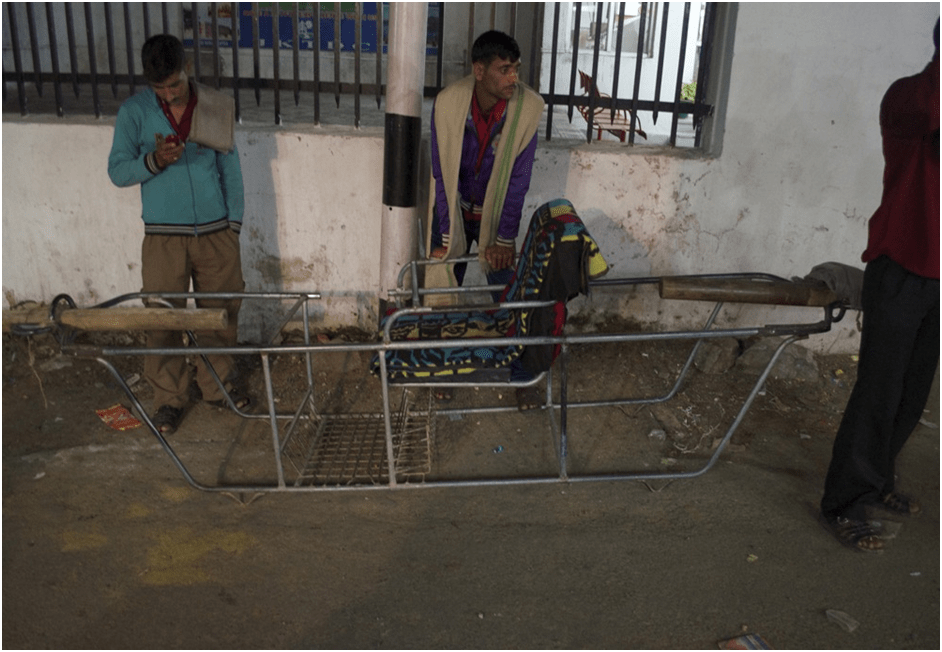
Palanquin and the carriers
**Vaishno Devi entrance at Ban Ganga**
Thousands of lights illuminated the entrance gate, and it was very crowded. Bapi purchased our “Yatra Parchhi” (entry ticket). Many people choose to walk at night, like us. Everyone must register with the Shri Mata Vaishno Devi Shrine Committee to enter. The identity of a pilgrim was also required.
We were a little lost at the gate, seeing the long lines.
“How do we get in? Look at the queue!!!” Shreya was a little confused.
My mother’s Palanquin carrier told us they could enter without inspection, so they took off. But wait… the officials informed us they couldn’t.
“I can’t see the Palanquin,” I screamed, feeling uncertain and unable to see my mother’s Palanquin nearby.
We ran everywhere to find them in the vast crowd. Pilgrims lined up but tried to push each other. They stuck their heads out to talk with the officials. This behaviour continuously derailed the queue. The official tried their best to control, but who was listening?
“This is insane,” Arpan was going restless.
At the entrance gate, the scene was chaotic. The long lines and everyone’s eagerness to earn piousness quickly created a sense of urgency and confusion. All in all, we experienced humiliation and uncertainty before we completed all the formalities and set off. Despite the challenges and the chaos, the pilgrims’ determination was inspiring, evidence of their unwavering faith and commitment to the pilgrimage.
Four Kashmiri men carried the Palanquin and promised to wait at every stop for my mother’s and our mental peace. The rhythm of their walk was fascinating. They stepped at the same pace and at the same time.
“Intriguing,” Arpan admired an appreciable rhythmic exercise!
The pilgrims can go to the shrine in two different ways. One is a paved pathway to let pilgrims stroll uphill gradually. Horses, Palanquin bearers, and Pittus also use this method. The other one is the stairs for the ones who wish to reach quickly.
**Vaishno Devi legends**
Vaishno Devi is one of the Shakti Peethas (or sources of power). According to legend, Sati, also known as Parvati, grew up in Prajapati Daksha’s household and later became Lord Shiva’s wife. Once her father insulted Lord Shiva, unable to accept her husband’s insult, Sati killed herself. When Lord Shiva heard of his wife’s death, his rage was illimitable. He held Sati’s lifeless body and began stalking the three worlds according to Hindu mythology. The other Gods trembled before His rage and appealed to Lord Vishnu for help. Lord Vishnu threw His 108 sharp-edged disc wheel. This is known as the Sudarshan Chakra, meaning wheel of good vision. It struck Sati’s body, cutting it into 108 pieces. The Vaishno Devi Temple is the most significant Shakti Peetha, as it is said to be the location where Sati’s head is believed to have fallen.
According to another legend, three goddesses—Maha Kali, the Goddess of Power, Maha Lakshmi, the Goddess of Wealth, and Maha Saraswati, the Goddess of Wisdom—merged into one force. Their purpose was to destroy evil energies (demons). This combined spiritual strength created a bright aura, and a beautiful young girl appeared.
The girl asked the goddesses about her mission. They instructed the divine girl to give birth to humans and then lead a life of spirituality and penance to raise her consciousness to Godhood. Her mission would be to uphold righteousness and justice and eliminate the demons.
Vaishno Devi was born on earth in Ratnakar and his wife’s house in South India. She portrayed herself as an honourable lady and attained higher spiritual awareness through mediation. Since her soul was of Lakshmi, She wanted to have Vishnu as her consort. She wished for the highest level of consciousness. Once achieved, she hoped to merge into Vishnu (the God of protection). She wanted to become one with him.
Vaishno Devi encountered Lord Rama during his 14 years of exile. She recognised him as the reincarnation of Lord Vishnu and requested that he merge with her to become one. Knowing it was not the right time, Rama directed her to meditate further in the Trikuta Hills in North India. He wanted her to elevate her spiritual level even further, bringing blessings to humanity and freeing the destitute from suffering. She came to the foot of the Trikuta Hills and continued meditating.
Her glory reached far and wide. Guru Gorakh Nath, a saint, followed the episode between Rama and Vaishno Devi. He became curious about whether she had attained the highest level of spirituality. He sent his disciple Bhairo Nath. Bhairo Nath became enchanted by her beauty and started stalking her. Vaishno Devi fled and started climbing up the Trikuta Hills to escape him. However, he kept following her. So, after stopping at places like Ban Ganga, Charan Paduka, and Adhkuwari (the places they are now called), she reached the holy cave shrine. Bhairo Nath followed her there. So Vaishno Devi had to kill him. Realising his sin, he requested forgiveness. She forgave him and gave him a boon. No Journey to Vaishno Devi would be completed without visiting Bhairo Nath in a nearby temple on the hilltop. Vaishno Devi left her human form in the holy cave shrine. She continued meditating and immersed herself in the form of a rock. This was to bless humankind and free the poor and destitute from misery. There are many legends about Vaishno Devi.
**Vaishno Devi: The Journey**
We wanted to reach Vaishno Devi on foot. We had no specific prayer in mind; instead, we aimed to immerse ourselves in the spiritual essence of the Yatra. The breathtaking night view of the mountains—the foothills, the path to the shrine, and the distant peaks—felt enchanting. This was the spirit I longed to experience. I wanted to embrace the mystery that captivated my senses and earn a sense of piety by feeling the presence of the Almighty in the vastness of nature.
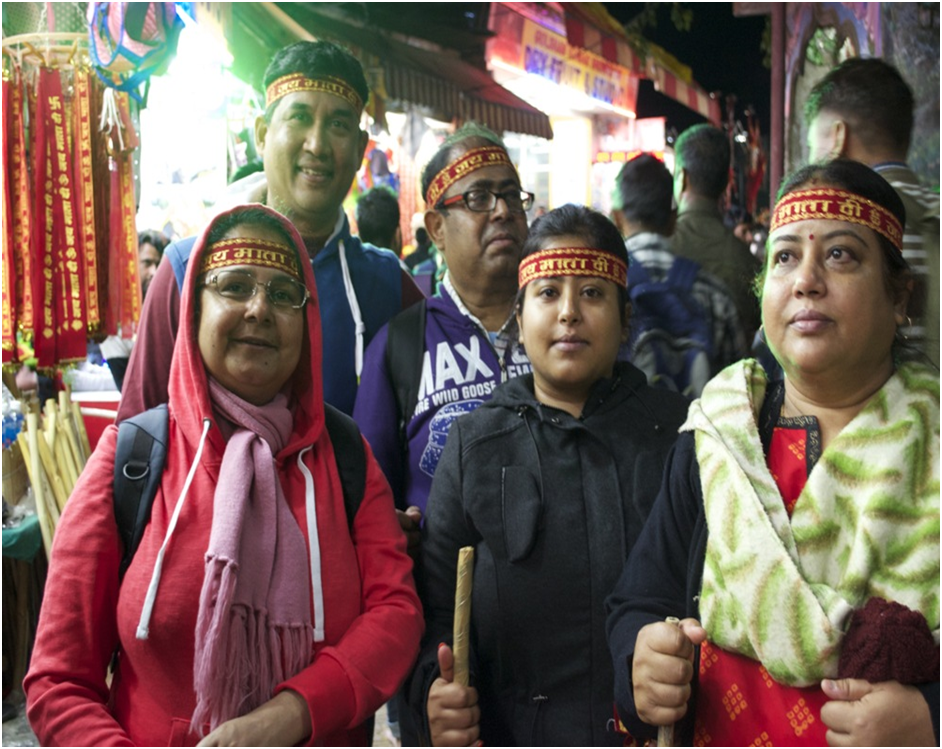
Ready to trek to Vaishno Devi Shrine
Arpan and I combined pathways and stairs to catch up with the palanquin bearers. Bapi, Rakhi, and Shreya opted for the path. We bought walking sticks and a headband that said “Jai Mata Di.” After their visit, we saw people coming down, satisfied and chanting “Jai Mata Di.” The pilgrims heading up joined their chant, and their incredible energy and passion were contagious.
“Jai Mata Di!” Rakhi led us with full vigour and enthusiasm.
“Jai Mata Di!” We matched her energy, ready to trek to the Vaishno Devi Temple.
The palanquin bearers were waiting at Charan Paduka, our first resting stop. Charan Paduka is 1.5 kilometres from Ban Ganga, situated at an elevation of 3,380 feet, where the footprint of Vaishno Devi is displayed on a rock slab. A hot cup of tea gave us the drive we needed after a short rest. Below, Ban Ganga looked mesmerising, with its illuminated pathway and twinkling lights in the distance. The night view from the Trikuta Mountain was magical. The twinkling lights of distant villages and the majestic Trikuta Mountain, all beneath a clear, starry sky, filled us with awe and wonder.
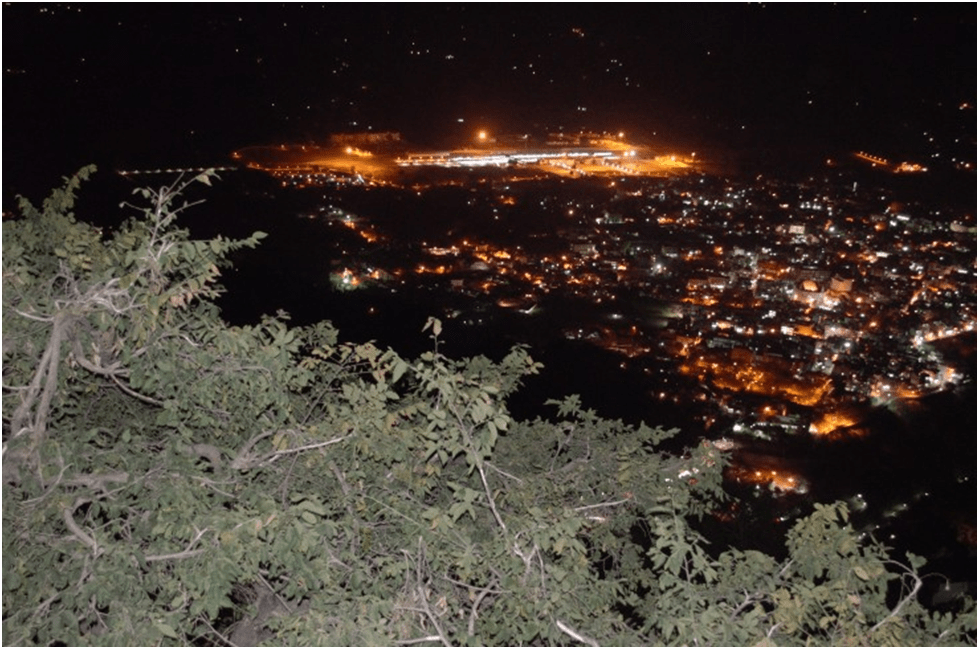
Magical night view from the Trikuta Mountain
Walking to the shrine felt like a spiritual journey. The breathtaking night view of the mountains, the foothills, the road to the shrine, and the distant peaks seemed like a scene from a dream. It was a moment of pure beauty and tranquillity. I felt like crying with joy and genuinely appreciating the atmosphere. One had to be there to truly feel the emotions. The pilgrimage was not just a physical journey but an emotional one, filled with moments of awe, joy, and spiritual fulfilment.
Next, we headed to ‘Adikuwari,’ our halfway mark at 3.5 kilometres from Charan Paduka, at 4,800 feet. Many people choose Adikuwari as an overnight stop. We waited for Bapi, Rakhi, and Shreya to catch up and celebrate completing halfway by sitting in a shop overlooking the fairy-like scenery below with coffee. The palanquin bearers were getting restless and wanted to proceed. It was hard for us to match their energy and vigour. The view from Adikuwari was stunning, but the camera couldn’t do it justice.
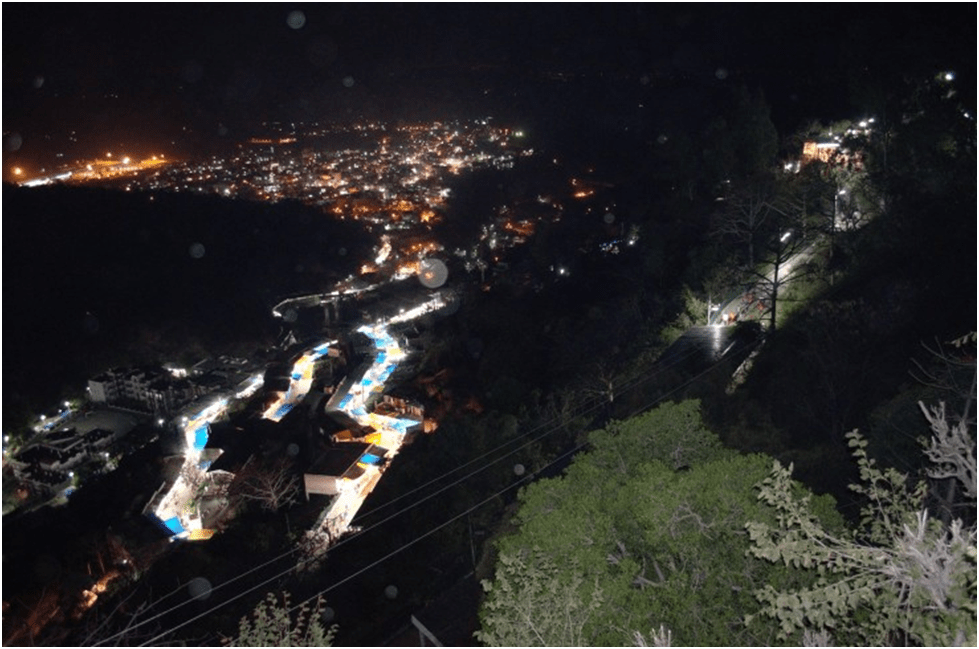
View from Adikuwari
Pilgrims were returning with smiles, chanting encouragement, “Keep walking; it’s not very far.” Young and old pilgrims, including frail individuals, made their way along the pathway with enthusiasm. Their mental strength was admirable, and their faith and conviction fostered a strong sense of community. We were all part of this shared journey, each step reinforcing our collective determination and belief. It was a powerful reminder that we were not alone in this spiritual quest.
The children were tired, but their parents encouraged them to keep walking together. I saw a little boy crying because, exhausted, he couldn’t continue to walk, but his father insisted he press on, even raising his hand at the child. The mother pleaded for a short rest, but her husband’s deaf ears ignored her. “Can’t you see how many people are walking? We’ll go back to the queue. Now come along quickly!” he screamed.
Meanwhile, wealthy families often carried their small children on the backs of locals called Pittus. Interestingly, some pilgrims were even receiving foot massages along the way. We felt like having one but resisted the idea, knowing that meeting the Palanquin at the next destination, “Himkoti,” would be challenging. The road was accessible and safe, with many people moving up and down. We had to be careful when horses passed to avoid getting hurt.
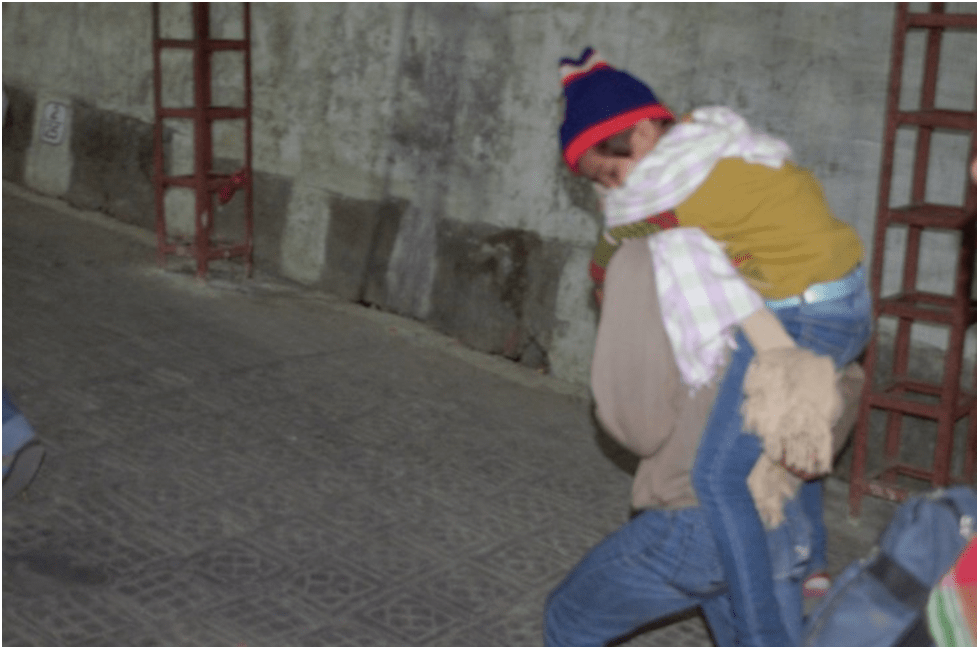
Pittu carrying children on the way to the Shrine
It was nearly 1:30 AM, and Himkoti, located 2.5 kilometres from Adikuwari at 5,120 feet, felt sleepy, with only one stall open. I was hungry and wanted a snack, but we didn’t see the Palanquin. They had not waited for us, so we took off immediately.
Numerous toilets were available along the route, but most were unusable. After huffing and puffing, we reached “Bhawan,” where the cave shrine is located, 2.2 kilometres from Himkoti at 5,200 feet at 3 AM. I breathed a sigh of relief upon seeing my mother. The palanquin bearers were very caring and helped her sit comfortably in a restaurant they mentioned before the start.
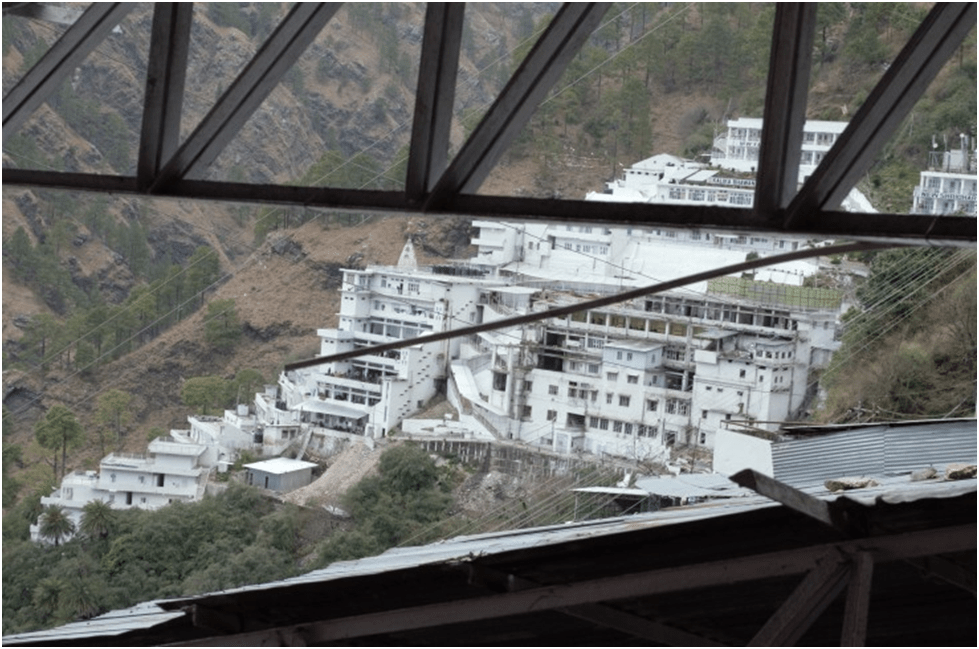
The Bhawan
**Disappointment at missing out entry to the Cave Shrine**
Unfortunately, we chose the wrong day. It was Ram Navami on a Saturday, which made the pilgrimage route overcrowded. People were queuing for up to 5 kilometres, making us unsure about visiting the cave.
“Look at the line and the mess on the road. How can we sit here?” I expressed my fatigue and confusion. “Do you want to visit the cave?” Everyone seemed unsure and tentative. Muddy water was everywhere, and donkeys crossing the path left the area messy and slippery. Pilgrims sat on the slick ground, testing their mental strength, adaptability, patience, and determination. I admired their depth of faith and belief in embracing the situation.

Pilgrims are queuing up
“It will take a good 10 hours to wait. Can you stand for that long?” Arpan asked, as sitting on the road was not an option. The thought of standing for 10 hours on the path was daunting, and the exhaustion from the walk was evident.
“And it will take a good 2.5/3 hours to walk to Sanji Chhad Helipad. We don’t have time.” Bapi spoke decisively.
Despite our best efforts, we still had to hike 2.5 kilometres and ascend 1,150 feet from here. We had pre-booked a helicopter for our return journey in a few hours, so we had to turn back without visiting the cave shrine. The disappointment was palpable, but our spirits remained high, knowing we had embarked on a journey of faith and endurance.
The incredibly clear blue sky provided solace as we ascended the mountain towards the Sanji Chhat Helipad. The panoramic view of the Ban Ganga River offered respite, and the distant villages were breathtaking. Strolling uphill along the winding path through the swaying pine and cedar forest felt like a blessing from Matarani.
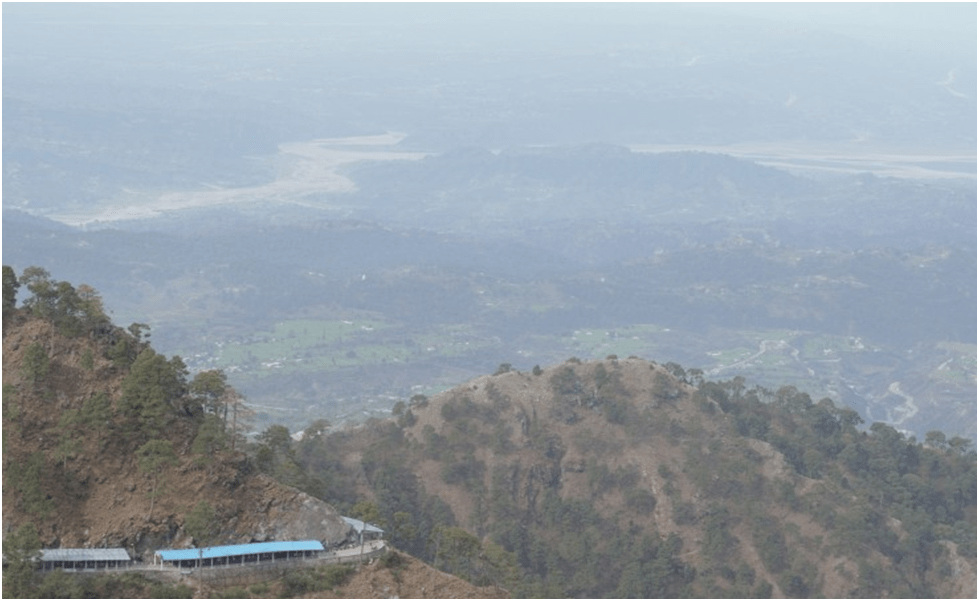
Incredible view on the way to Sanji Chhat Heli Pad
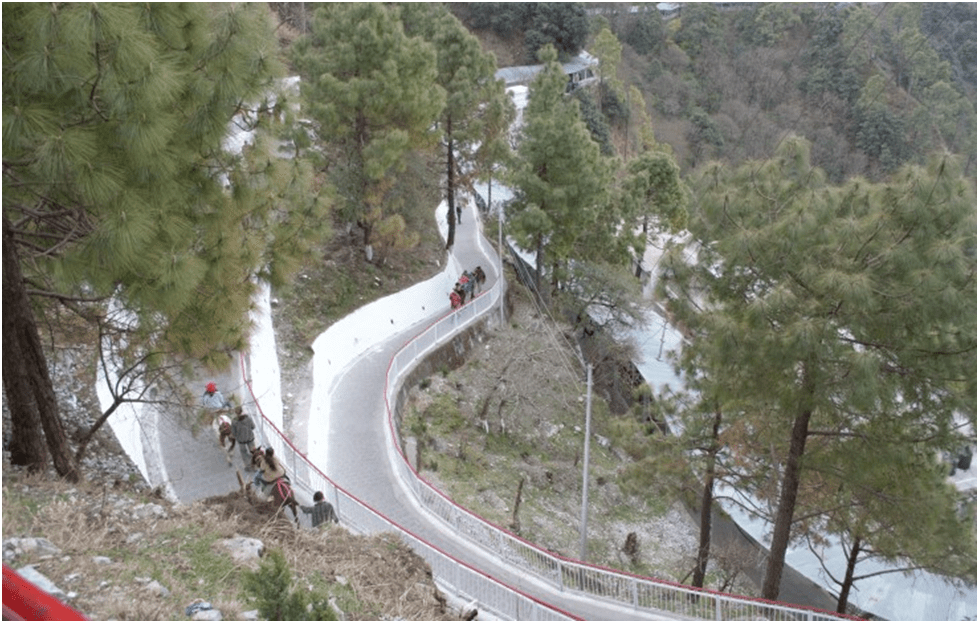
Winding Path to Sanji Chhat
Only one family was allowed to board the helicopter at a time. As soon as the aircraft took off, we felt butterflies in our stomachs. We caught our breath, steadied our hearts, calmed our nerves, and soaked in the experience during the ride. Our first helicopter trip was over before we even realised it. It was a thrilling experience!
My mother perfectly captured the essence of the trip when she said, “The trip down is over in 2 minutes,” especially considering the hours it took to climb up.
Afterwards, we took two auto-rickshaws and called Amitda to order pakoras and tea at the hotel. My heart was filled with joy. In the vastness of nature, I felt the mystery and spirituality of the all-powerful existence. The journey was truly extraordinary.
“Thank you, God, for this opportunity,” I felt grateful for my good fortune.
* Palanquin—A palanquin in Vaishno Devi Shrine is an open portable couch mounted on four poles, each carried on the shoulders of porters. The Palanquins (Palki) presently used were built with galvanised iron pipes. Carrying the pilgrim’s weight, his/her luggage, and the palki’s weight on the trek to Vaishno Devi is a highly strenuous task for the porters, but this is a means of their livelihood. The Palanquin is usually hired for senior citizens and physically challenged people.
 callofthefar.com
Leave a Comment