
Sydney to Negombo
Visiting beautiful Sri Lanka, the “Land of Ravana,” the mythological demon in the Ramayana who abducted Sita, was always on my wish list. Following the legend, I was keen to see the place where Sita was kept captivated. This country’s lush green valley, tea plantations, waterfalls, and little hills mesmerised me, and I was looking for the opportunity.
We reached Colombo Airport one hour later than the scheduled time as the flight departed late from Singapore. Thank God, immigration and customs were smooth. We were relieved to see Richard, our smiling pilot for the night transfer, waiting outside. Being a proud Sri Lankan, he was enthusiastic about showing off lovely Negombo in the 30 to 40-minute drive to our guest house, though most places were closed. Thankfully, our host, Andre, waited for us when we reached around 1.30 a.m. and allocated a decent and spacious room compared to the price we paid to sleep the night. We hope we didn’t wake other residents up. It felt so quiet, with no other people around.
Negombo and surround:
It was hard to sleep well because our minds were vigilant from the travel, and we were jet-lagged. Breakfast was simple but enjoyable, with a few courses. The golden tea they served us was the best tea we drank in Sri Lanka. I loved its rich golden colour and flavour. Later, I asked Andre about the brand and tried to find one on the tour, but I couldn’t find one anywhere.
Arpan suggested walking around the guest house to better understand the area, although it was drizzling. We could hear the sound of the sea nearby. Wandering through the area and the beach in the drizzle felt fantastic. The beach seemed to be sleeping, with a few fishing boats scattered, and no one could be seen around.
Our driver/guide for the tour, a friendly gentleman called Manjula, came to pick us up from the hotel around 9.30 a.m. He drove us to a beautiful Buddhist temple called Angurukaramulla Temple, with a dragon head that guards its entrance and a six-metre-tall statue of Lord Buddha, which can be seen from afar. The beautiful century-old paintings, sculptures and murals depicting Jataka stories and Lord Buddha’s journey to enlightenment on the ceiling are captivating. The Hindu Temple at the rear made the temple a pilgrimage for both Buddhists and Hindus. Perfect start to the day, and we gained knowledge from the paintings and the intricate images around us, loving the beautiful Buddha statue outside.
Sri Lanka’s predominant population consists of Sinhalese, who follow Buddhism. The Tamil people, on the other hand, follow Hinduism. Negombo is called ‘Little Rome’, and a few Roman Catholic churches are nearby. Christianity is prevalent.
A little canal appeared on the side, and we learned that it was created by the Dutch to connect Puttalam and Colombo through Negombo. This made it easier for them to drain the salt water away from their rice fields and conduct barges that carried cinnamon to their seaports in Negombo. There are many things to know and a lot of history about the places. Fascinating!
On our way to the impressive Dambulla Cave Temple!
After quickly changing our currency, we started for the Dambulla Cave Temple, a very peaceful drive through the lush green vegetation on both sides, and we couldn’t help but admire the impressively clean roadways, making our trip enjoyable.
When we reached around 2:30 p.m., the rain started heavily. We were tired and felt so sticky. The stairs to the temple were slippery, and although the steps were not very high, we wondered whether we wished to climb 364 steps to the Cave Temple. It’s a lot of steps for a physically unfit person like me on a very sticky and steamy rainy afternoon.
‘If we don’t do it now, we will never do it’, I thought and gathered the energy and courage to climb.
Manjula gave us umbrellas to protect us from getting wet. We climbed only a few steps and felt we couldn’t do it, especially me. We rested and took a few steps at a time. Finally, we reached the top, and the view was magical. The climb was challenging, especially since I had not slept well the night before. My effort delighted me, and I was blessed with a fantastic panoramic view in return. It was very satisfying!
They offer sarongs if someone needs to be dressed appropriately. The Dambulla Rock Cave Temple was first built by King Vattagamini Abhaya between 103 BC and 89-77 BC and is 1118 feet above sea level, raising a massive rock. It is one of the world’s most admired Cave complexes, with exquisite Buddha statues and vibrant rock paintings in vibrant colours and shapes. Sinhalese call it the ‘Dambullu Gala’ ( Dambulla Rock), and the temple is named the ‘Rangiri Dambulla Viharaya’ (Golden Rock Dambulla Temple).
There are superb Buddha statues in various poses, including statues of ancient kings Vishnu and Ganesh. Looking at the ceiling and walls, which contain a combination of metaphors, including royal life, I told Arpan, “Thank God I didn’t give up,” and awarded the experience of fantastic artwork.
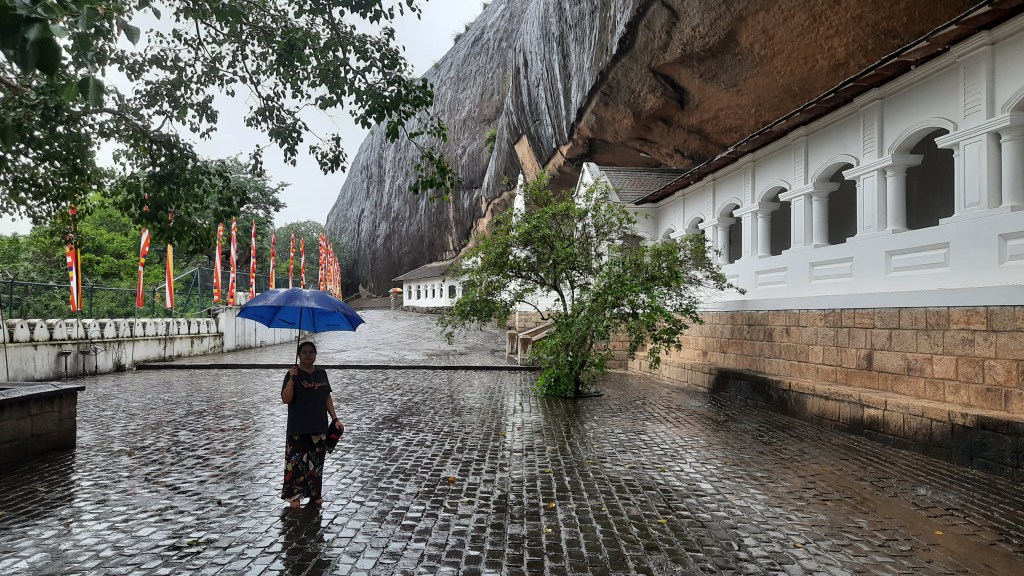
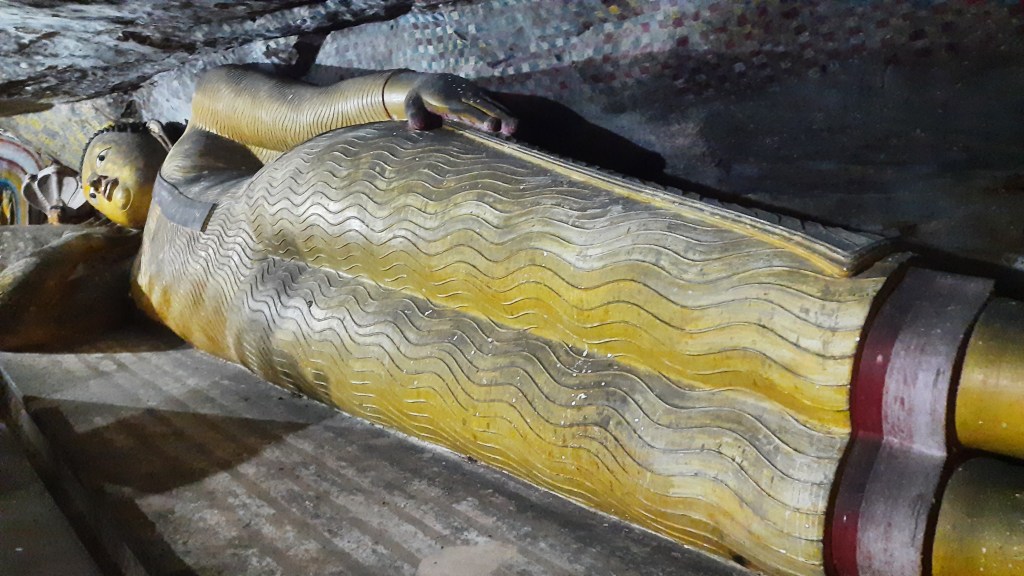
Going down the steps was easy. We met a young family of 7 and 12-year-old boys. When Arpan lauded the little one for climbing 364 steps, their father said they also did a 1200-step Sigiriya Rock climb today. What energy!!!
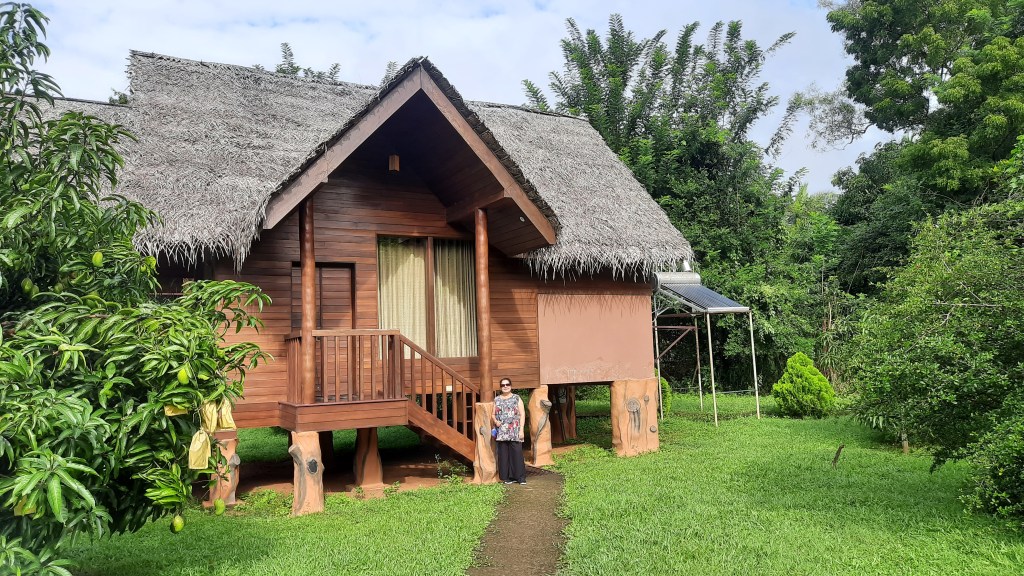
The rain didn’t stop. Manjula drove us through beautiful, dense tropical woodlands to the lovely town of Sigiriya. Sigiriya’s natural environment and thriving wilderness maintain its connection to the elephant corridor. We booked a resort surrounded by trees, especially 30 different mango trees,s and we were thoroughly impressed. The cottage is secluded and has everything one needs in such an area. I was thrilled when told that sometimes wild elephants break free in the area. We deserved rest after the hectic itinerary.
I ordered the roti bread mixed with vegetables and chicken at Pradeep restaurant, and it was one of the most sumptuous dishes I tasted. The restaurant uniquely collects reviews on the walls, posts, and even on the doors – I was thrilled to add our autograph to the wall.
Polonnaruwa Adventure
Breakfast was a highlight at this place, as they served yummy Sri Lankan dishes and a fruit plate decorated with seven fresh fruits grown in Sri Lanka. It was very satisfying!
Per our itinerary, we were supposed to see The Sigiriya Rock Fortress with 1200 steps, but we drained out from the ascending to Dambulla Cave Temple and acclimatisation yesterday. We didn’t want to get up very early in the morning on consecutive days. So, we scheduled Sigiriya Rock for the following day. Manjula suggested we travel to Polonnaruwa from Sigiriya instead of Anuradhapura, which was on our itinerary.
He told us, ‘Polonnaruwa is better preserved. Anuradhapura takes longer to travel, and the area is much bigger with the sheer scale of ruins.”
‘Yeah, something to think about in the steamy weather,’ we thought and finalised on Polonnaruwa instead.
Leaving Habarana National Park on the left, we drove to the right. Minneriya National Park, famous for its elephant sightings, appeared on our right-hand side. This path is a renowned elephant corridor. If lucky, we could bump into them.
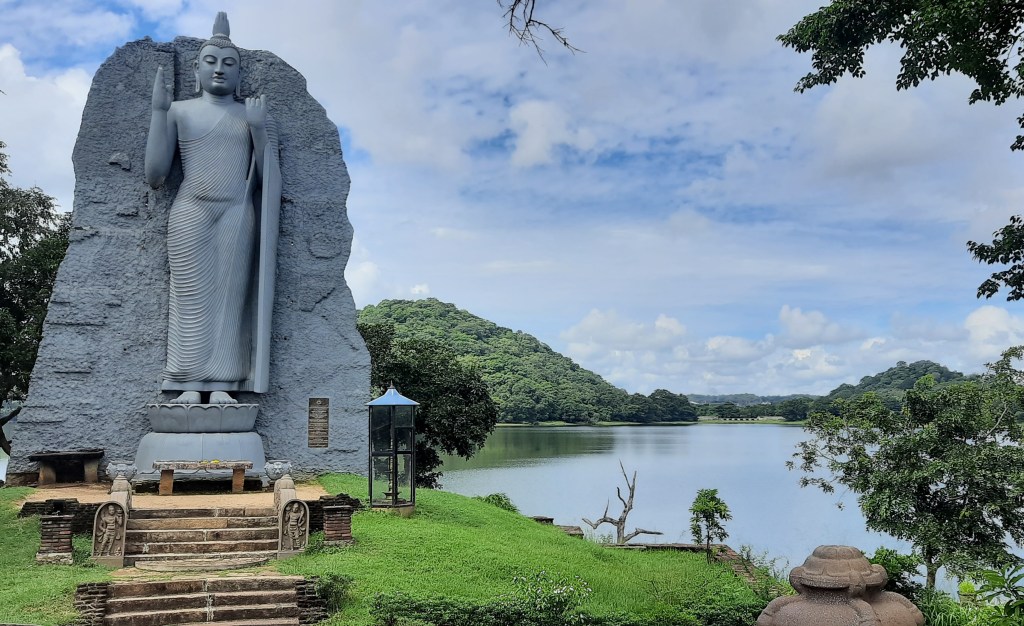
We stopped by a vast, beautiful Buddha statue by Giritale Lake. The place with the lake behind it was so calm and peaceful that we sat there for some time.
Polonnaruwa developed into the second capital of Sri Lanka after the eradication of Anuradhapura in 993. In addition to a few monuments built by the Cholas, it comprises the ruins of the beautiful garden city constructed by King Parakramabahu I in the 12th Century. Polonnaruwa later lost its prosperity after the town was abandoned after a series of civil wars and invasions and overtaken by the jungle. After purchasing the entry tickets, we visited the archeological museum first and then drove through the complex to see the famous spots. It is a vast area.
The enormity of the great Polonnaruwa Parakrama Samudraya (Polonnaruwa Tank) was startling. This enormous tank once included 5 large reservoirs and, amazingly, helped with the cultivation in different parts of the area in those days.
The Polonnaruwa ruins comprise unique stupas, well-preserved temples, and pleasant Buddha statues. The Sacred Quadrangle is one such ruin, with a grand area and abundant well-preserved buildings. If visitors are interested, it is home to the Sathmahal Prasadaya, Thuparama Image House, Hetadage, Bodhi Tree Shrine, and the Polonnaruwa Vatadage.
Among the primary buildings is the Royal Palace of King Parakramabahu I, its greatest monarch. It was initially a structure of seven stories in height and believed to have about 1,000 chambers. However, all that’s left is the lowermost floor, the remains of some brick walls that do not look like much of anything to us, but in reality, they still bear traces of the original plaster that covered the bricks. The palace is a reminder of the kingdom’s grandeur and the evidence of the architectural excellence of the ancient kingdom and the country’s illustrious history after constant invasions.

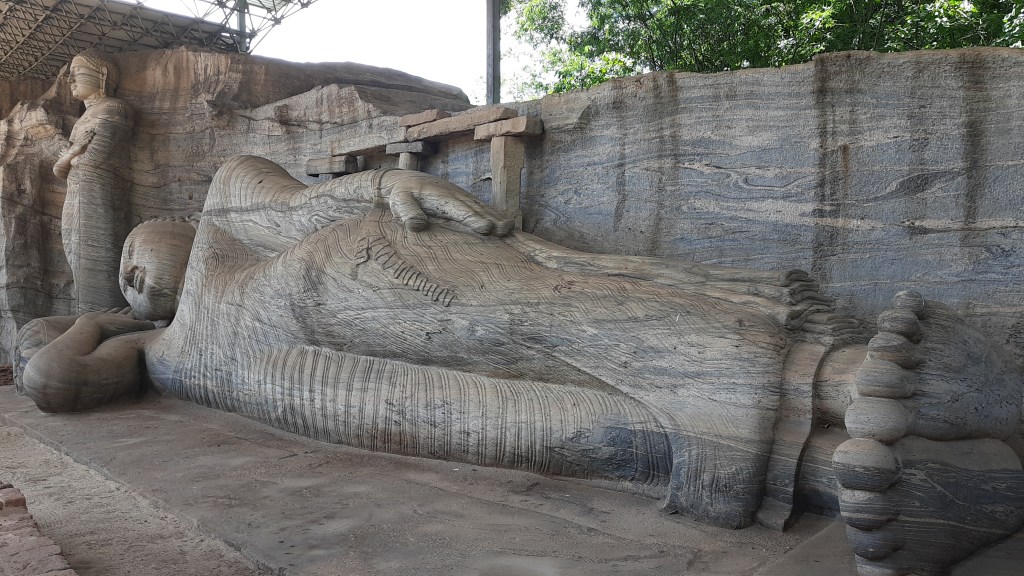
Polonnaruwa Vatadage was constructed to house the significant ‘Sacred Tooth Relic’, now kept in Kandy. Gal Vihara stands out here. The aesthetics and unique size of giant sleeping, standing, and reclining Buddha statues, directly carved from a large granite rock facade, with immense artistic value, make it my favourite site in Polonnaruwa. The stone looks unique with a lined texture. The images were so beautiful that I could spend a long time looking at those statues.

King coconut water is a must after walking in ruins in this sticky weather. Its sweet and delicious taste took away all our tiredness. Lots of stray dogs were moving around. We ended our time in Polonnaruwa by feeding them biscuits from the nearby shops. It had been a long day!
On the way back, I took a little nap when Manjula suddenly woke me up. “Look, a wild elephant on the road.”
“I can’t believe it. We are seeing a wild elephant roaming freely on the road?” My eyes popped up. The elephant probably came out of Minneriya National Park. Our car stopped a few meters from him. “A giant male,” Manjula murmured. He appeared on our side. Ignoring us, he kept on eating the leaves from the tree. We couldn’t believe our luck—a wild elephant so close had never had this experience. I stopped breathing when he went past our car, stopped again behind, and kept eating leaves from another tree.
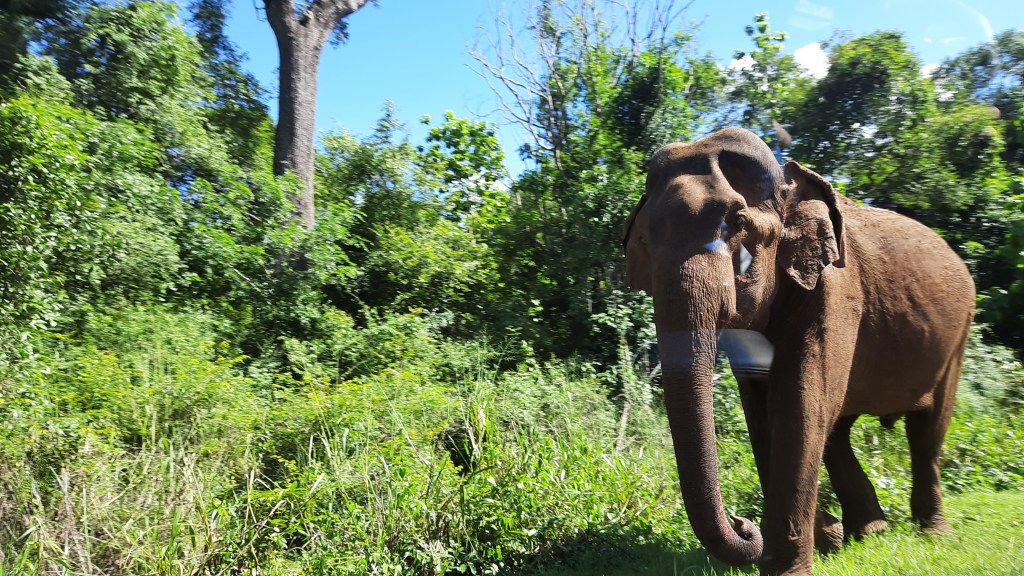

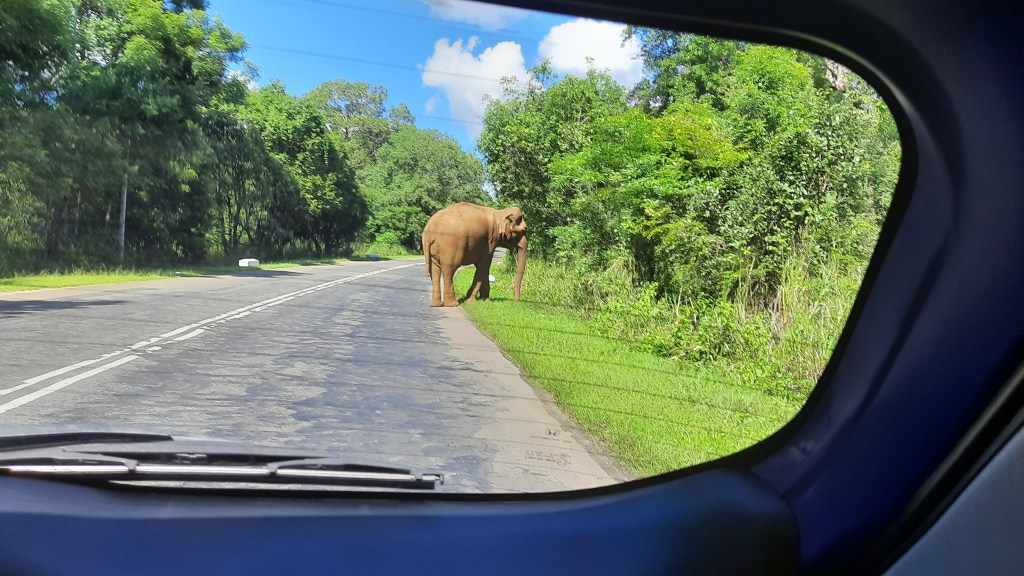
God had been too kind to us, and another elephant, even more gigantic than the one we had seen before, appeared on the other side of the road. ” Another bull. You must be fortunate”. This time, he didn’t ignore us. When he saw our car stop, he tried to cross the road and come to us directly.
“He wants food.” I got a bit scared as he was coming directly to me. I requested Manjula, “Start the car, please.” Then, the elephant stopped while trying to cross the road. The traffic was constant. As he was stepping onto the road, a big truck honked to alert him from coming in the middle of the road. He stepped back and stood there. We waited a few more minutes, but he didn’t cross the road. We were so blessed. They usually come towards the car to get food. Often, tourists stop their vehicles and offer them food.
Incredible Sigiriya Rock
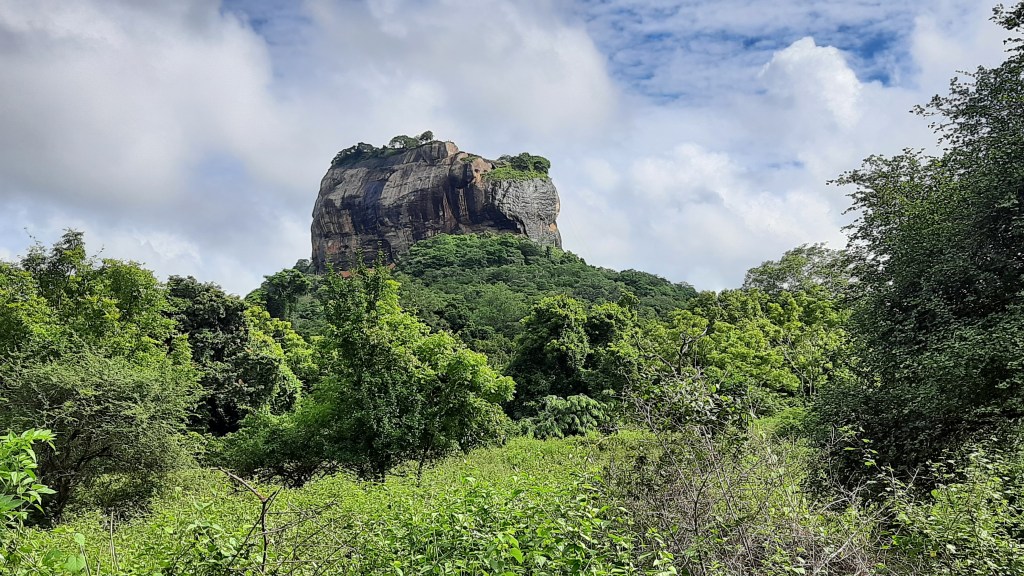
Manjula dropped us off at the Sigiriya Rock entrance just before 6 a.m. He parked his car at the exit parking place after giving instructions on how to start and finish the climb. It was nice and windy, so we felt a lot cooler. Big groups with the guide have begun already. We didn’t hire one as we read the contents and significance of the place beforehand. The rock looked huge from the base, and I wondered whether I could climb at least half of it. There are 1200 stairs to go to the top. The cooler weather in the morning gave me some hope. Also, there are a few points where we could rest and enjoy.
Sigiriya Lion Rock is known for its massive rock column, which reaches nearly 200 meters high. The rock dates back to King Kasyapa’s (477-495 AD) period, who chose this site as his new capital. The flat top was believed to be the site of Ravana’s majestic palace. It was made of solid gold and created by Kubera, the God of Wealth.
Starting from the Fountain Garden and passing through the leaning Boulder Garden, we first stopped at the Terrace Garden. Up to this point, we climbed quickly. Then we slowly walked up, taking our time while enjoying the small decorated caves depicting the stories from Ramayana. We sat there on the decorated bench, admiring the surroundings. It was a lovely lookout.
Climbing to the Mirror Wall through two massive brick stairways leading up through several terraces to the spiral staircase was challenging. I was a little scared, but a gentleman who guided a Lithuanian group encouraged me. ” Go up, Ma’am. You can do it. See many older people going up”. He was so kind to encourage me by giving me extra support and holding my hand to pass a couple of scary turns. There was a platform at the top of the spiral stairs where we caught our breath to admire the scenery. A narrow spiral metal staircase approached the Sigiriya Frescoes 20 meters above the Mirror Wall walkway. Painted more than 1600 years ago, the frescoes portrayed the ladies of King Kasyapa’s harem. Dressed in beautiful garments and the finest jewellery, they are well worth seeing.

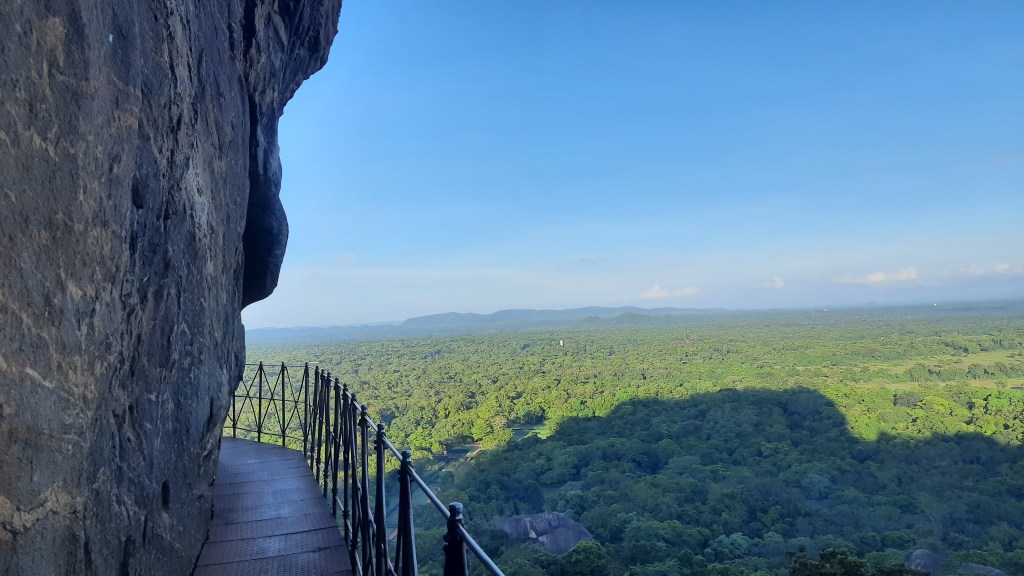
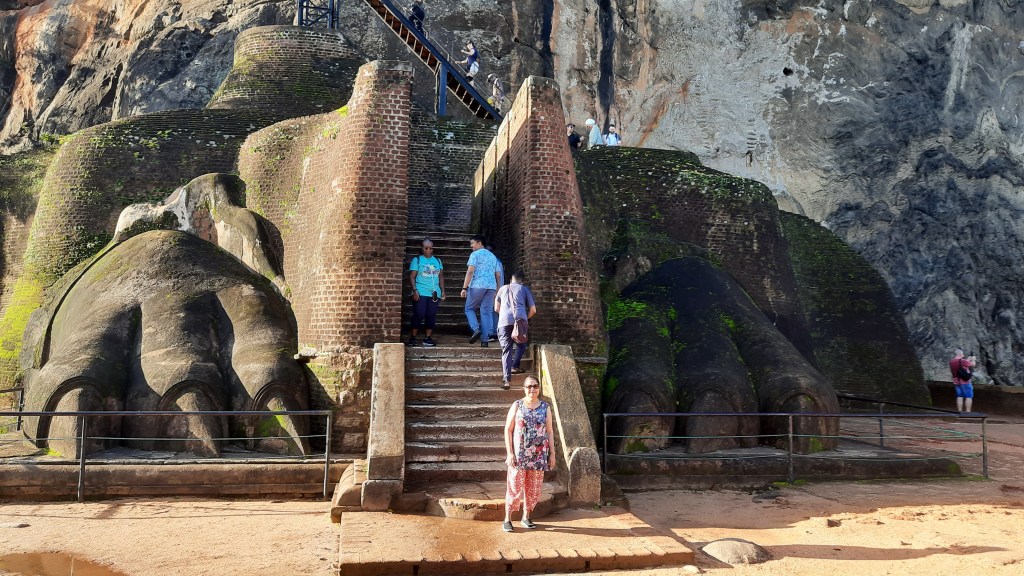
Our next stop was Lion’s Paw. I was exhausted. I met the gentleman again. I asked him, “How many steps did I cover?” He replied, “900 and 300 more, you will reach the top.” Lion’s Paw is a vast sitting area where many visitors rest after coming so high up. The guide, Rangan, a self-declared, proud Tamil Sinhalese, started a conversation with me about the tourism situation in Sri Lanka. He reckoned it was on the way up. Sri Lanka is very popular with the Eastern European people, mainly Russians and Ukrainians. I asked him, “Why don’t I see many Indian tourists here? I see people from Europe, America and Australia.” He educated me, “Indians normally take Ramayana tours and travel south of Sri Lanka the most.“
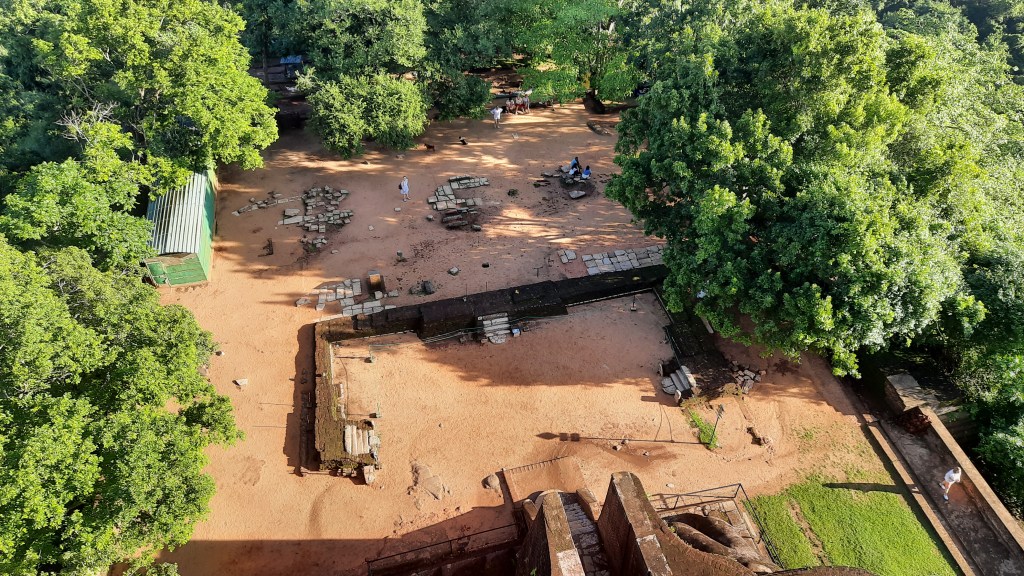
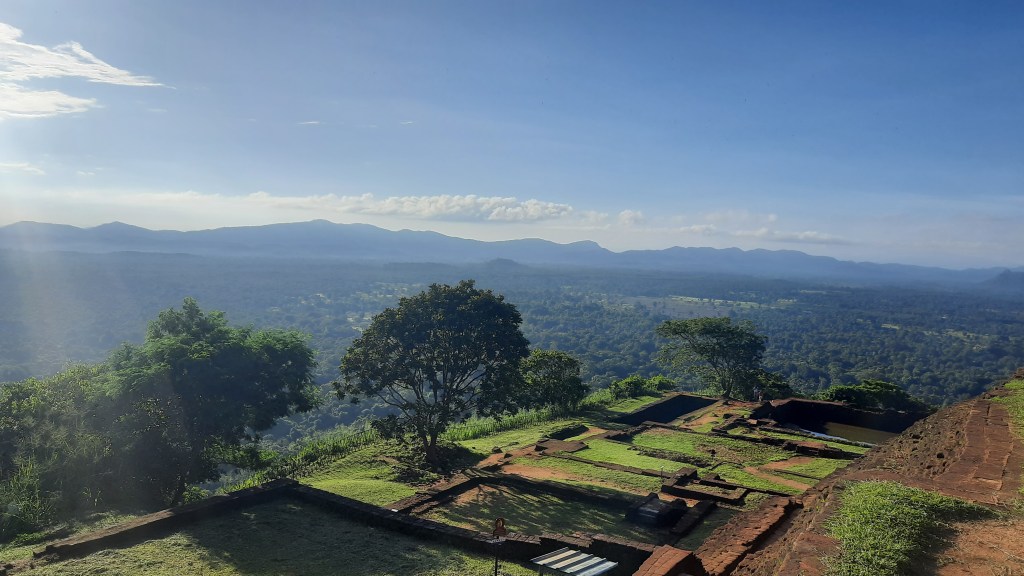
Arpan went to the top and I was waiting at the Lion’s Paw, I talked to Rangan, who gave me lots of information about Sri Lanka. “A rare 360-degree view, fantastic! You missed it.” Arpan was trying to make me jealous. Ha ha! Coming down was effortless. We came out around 9 a.m.

 callofthefar.com
Leave a Comment