
According to legend, Maha Kali (the Goddess of Power), Maha Lakshmi (the Goddess of Wealth) and Maha Saraswati (Goddess of Wisdom), different incarnations of Ma Durga (Principal Hindu Goddess) merged into one force to destroy evil energies (demons). This combined spiritual strength created a bright aura, and a beautiful young girl appeared.
The girl asked the goddesses about her mission. They instructed the divine girl to take human birth and then lead a life of spirituality and penance to raise her own consciousness to the level of Godhood. They also told her that she would automatically merge into and become one with Lord Vishnu once she had reached that level of consciousness. Her mission would be to upholding righteousness and justice and to eliminate the demons.
There are many legends about Vaishno Devi. Vaishno Devi Shrine is located on the Trikuta Hill in Katra near Jammu in Jammu and Kashmir, India.
A magnificent view of the Tawi River and mountains welcomed us as we left Jammu. The journey through the winding road with swaying pine trees on both sides and the gentle breeze was thoroughly soul-satisfying. Everyone in the car was quiet, soaking into the journey. We couldn’t take our eyes off this stunning landscape until our car stopped at a checkpoint. The soldiers dealt with the security inspired us by chanting “Jay Mata Di” (Hail/Victory to Mother Goddess), a special ode to Vaishno Devi, and wishing us luck.
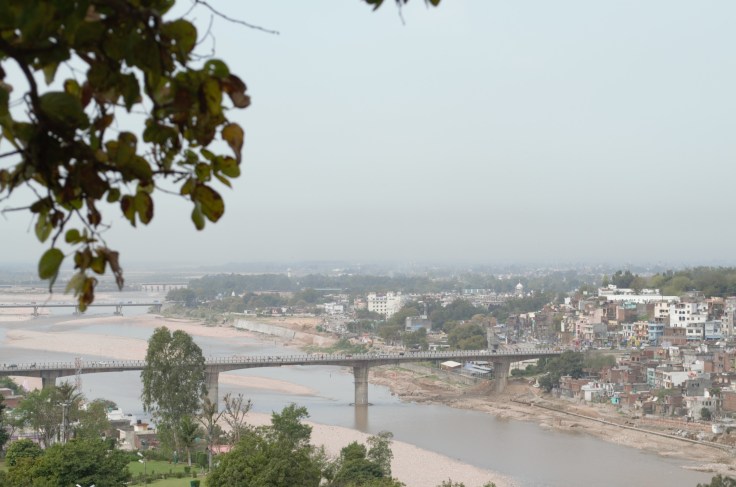
We checked in at a hotel in Ban Ganga at an altitude of 2800 ft near Katra, little closer to the Shrine. My mother Maya, cousin Bapi, his wife Rakhi and daughter Shreya, my husband Arpan and I were looking forward to starting our journey around 8 PM to avoid the heat. My sister-in-law Rekha and Amit were lucky to have already visited the Shrine.
After having a few hours rest and light dinner, we were all excited, ready to hike up.
My mother was delighted to see her “Palanquin” **, but a bit sceptical, “Sure they won’t drop me?”
“Relax aunty; they are experts, will take a good care of you” Bapi assured.

Helicopter service, Mule/Pony/Horse riding or Palanquin were available to hire. Still, we choose to walk to get the feel of walking together with the other pilgrims in this sacred journey. It was a kind of spiritual fulfilment we wanted to achieve while enjoying the scenery around us.
Thousands of lights illuminated the entrance gate, and it was very crowded. Bapi purchased our “Yatra Parchhi” (ticket). Many people choose to walk at night like us. Everyone needed to register with the Shri Mata Vaishno Devi Shrine Committee to enter. The identity of a pilgrim was also required.
We were a little lost at the gate seeing the long lines.
“How do we get in? Look at the queue!!!” Shreya was a little confused.
The carrier of my mother’s Palanquin told us that they could enter without inspection and took off. But wait… they couldn’t.
“I can’t see the Palanquin,” I screamed being very uncertain.
We ran everywhere to find them in the vast crowd. Pilgrims lined up but trying to push each other and sticking their heads out to talk with the officials continuously derailing the queue. The official tried their best to control but who was listening?
“This is insane,” Arpan was going restless.
Total confusion; it seemed everybody wanted to earn piousness in a hurry. All in all, we experienced humiliation and uncertainty before we completed all the formalities and set off.
The Palanquin was carried by four Kashmiri men who promised to wait at every stop for my mother’s and our mental peace. The rhythm of their walk was fascinating. They were stepping on at the same pace and same time.
“Intriguing,” Arpan admired an appreciable rhythmic exercise!
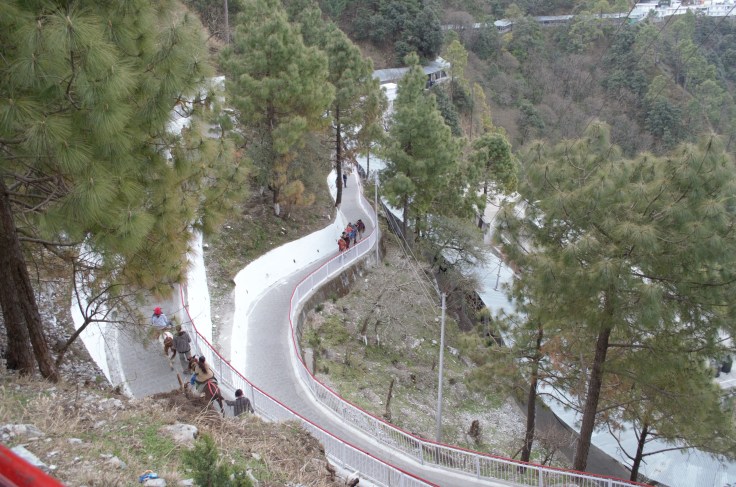
The pilgrims can use two different ways to the Shrine. One is a paved pathway to let pilgrims stroll uphill gradually. Horses, Palanquin bearers and Pittus also use this way. The other one is the stairs for the ones who wished to reach quickly.
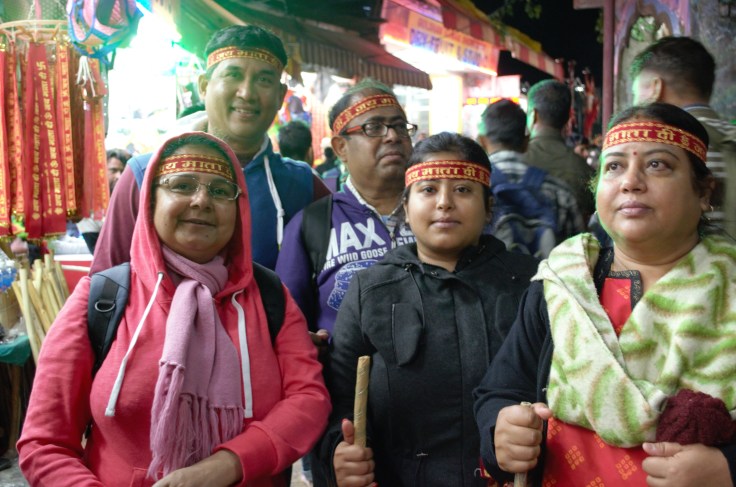
Arpan and I chose to combine both as we had to catch up the Palanquin bearers. Bapi, Rakhi and Shreya took the pathway. We bought the walking sticks and the headband written “Jai Mata Di” on it. We saw people coming down satisfied chanting “Jai Mata Di”, “Jai Mata Di” after the visit. Pilgrims going up joined their chant. Their incredible energy and passion were transmissible.
“Jai Mata Di” Rakhi led us with full vigour and oomph.
“Jai Mata Di” We matched her energy.
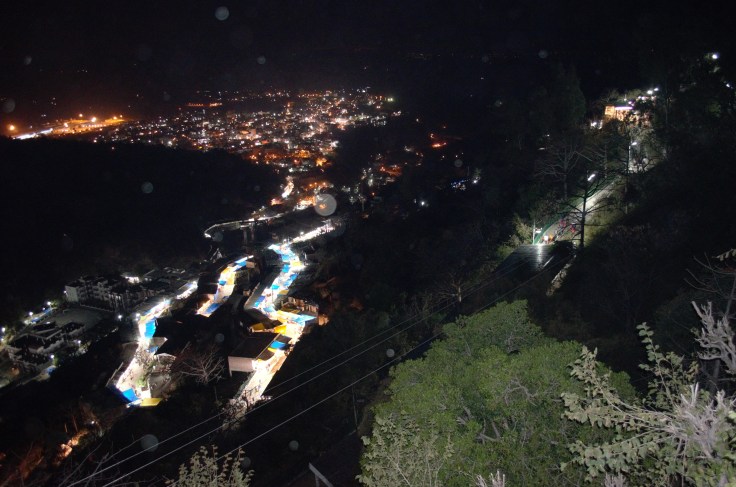
The Palanquin bearers waiting for us at a place called “Charan Paduka”, our first resting stop on the way. Charan Paduka is located 1.5 kilometres from Ban Ganga at an altitude of 3380ft. We visited the temple with Vaishno Devi’s feet impression displayed on a rock slab. Little rest and hot cup of teas provided us with the drive we needed. Ban Ganga below looked mesmerising from here with the illuminated pathway and twinkling lights far away.
Walking to the Shrine was a journey in itself, and I wanted to feel it spiritually. The breathtaking night view of the mountains, the foothills, the road to the Shrine, and the distant mountains was like magic. I felt like crying with joy. One had to be there to feel the emotions.
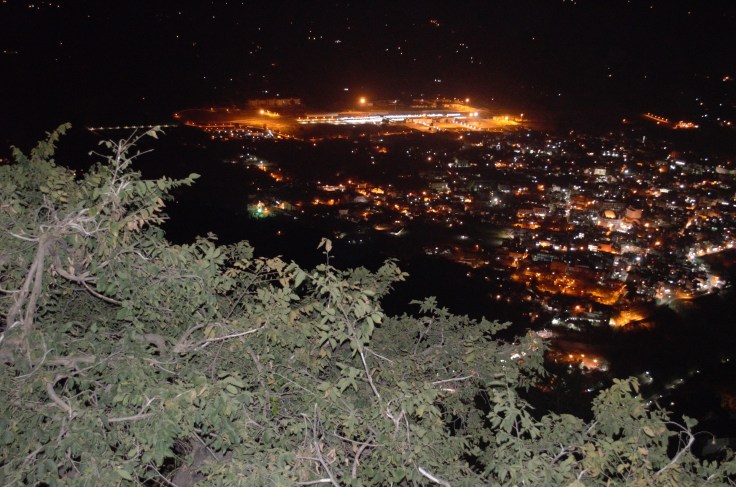
“Adikuwari” was the next destination. The place is halfway to the Shrine. Adikuwari is located 3.5 kilometres from Charan Paduka at an altitude of 4800ft. Many people also choose Adikuwari as an overnight stop. We waited for Bapi, Rakhi and Shreya to join us. To celebrate reaching halfway with coffee, we sat in a shop overlooking the fairylike scenery below. The Palanquin bearers were getting a bit restless and wanted to proceed. It was hard to match their energy and vigour. We had to start again.
Pilgrims were coming back with a smile on their face and chanting. They comforted us, “Keep on walking, not very far.”
Pilgrims young and old, and even frail people walking along the pathway with enthusiasm; their mental strength, faith and conviction were admirable.
The children were tired, but the parents encouraged them to walk together. I saw a little boy crying because he couldn’t walk anymore, but his father insisted that he continue. In the process, he beat his son. The boy’s mother’s request to stop and give him a short rest went on to the father’s deaf ears.
“Can’t you see so many people walking? We will go back to the queue. Now come along quickly,” he screamed.

Small children from wealthy families were carried by Pittus (locals taking children at the back). It was interesting to see some of the pilgrims were even getting foot massages. We felt like one but resisted the idea as it would be challenging to meet the Palanquin at the next destination “Himkoti”. The road was all paved and very safe throughout the journey, with many people going up and down. We had to be careful when the horses passed us to avoid bumping on them and getting hurt. It was nearly 1:30 AM, and Himkoti was sleepy with only one stall was still opened. Himkoti is located 2.5 kilometres from Adikuwari at an altitude of 5120 ft. I was hungry by then and wanted a snack, but we didn’t see the men. They didn’t wait for us. We took off immediately. There were many toilets on the way, but most of them were not usable. After huffing and puffing, we reached “Bhawan.” (where the Cave Shrine is – 2.2 kilometres from Himkoti at an altitude of 5200 ft) at 3 AM and breathed a sigh of relief after seeing my mother. The Palanquin bearers were very caring and got her to sit in a comfortable restaurant there.
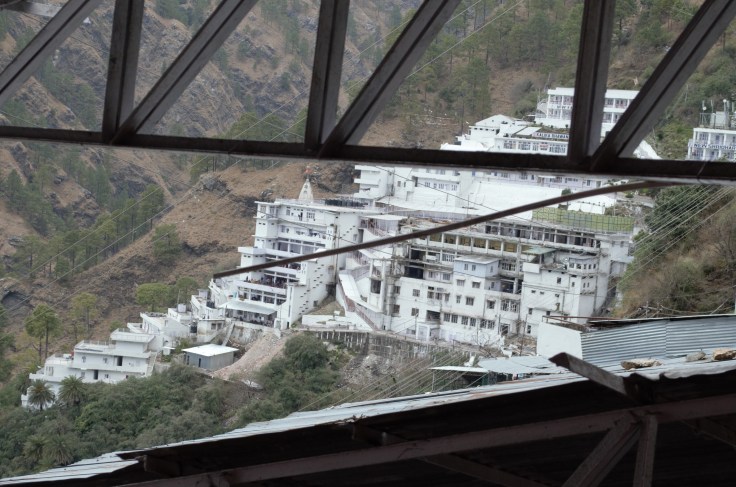
We chose a wrong day (Auspicious Ram Navami for Hindus and a Saturday) and found pilgrimage was choker and people were lined up to 5 km making us unsure about visiting inside the cave.
“Look at the line and the mess on the road. How can we sit there?” Being tired, I was in two minds; “Do you want to visit the cave?”
Everybody seemed confused and tentative. Muddy water everywhere and the donkeys crossing path dropping their loads made the place very ugly and slippery. The pilgrims were sitting on the slippery path. It was a test of mental strength and adaptability, patience and determination. I salute the people who attained that kind of faith and belief to embrace this situation.
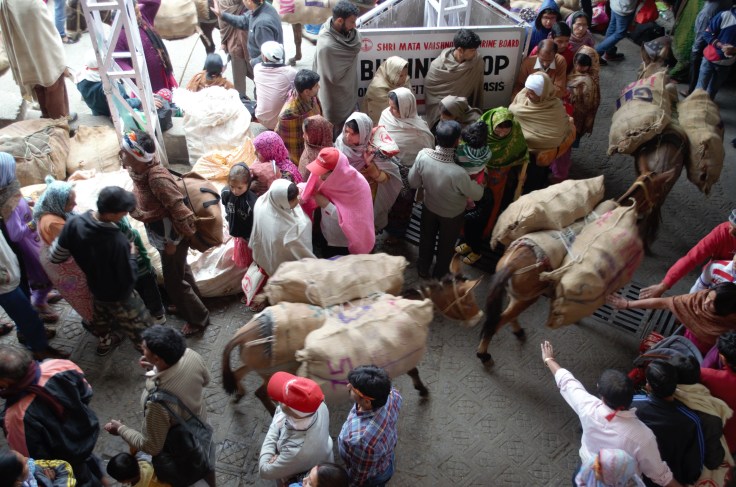
“It will take good 10 hours waiting. Can you stand for that long?” Arpan asked as there was no question of sitting on the road.
We definitely couldn’t, and it was impossible to stand on the path for that long. We were exhausted from the walk.
“And it will take good 2.5/3 hours to walk to Sanji Chhat Helipad. We don’t have time.” Bapi spoke decisively.
We still had to hike 2.5 kilometres and 1150 ft uphill from here. We pre-booked to return by the helicopter in a few hours, so we had to come back without visiting the cave shrine.
While going up the mountain to Sanji Chhat Helipad, we took solace from the incredibly clear blue sky, Ban Ganga River and the distant villages’ panoramic view. Experience of strolling uphill through the winding path with swaying pine and cedar forest was blessings from Matarani.
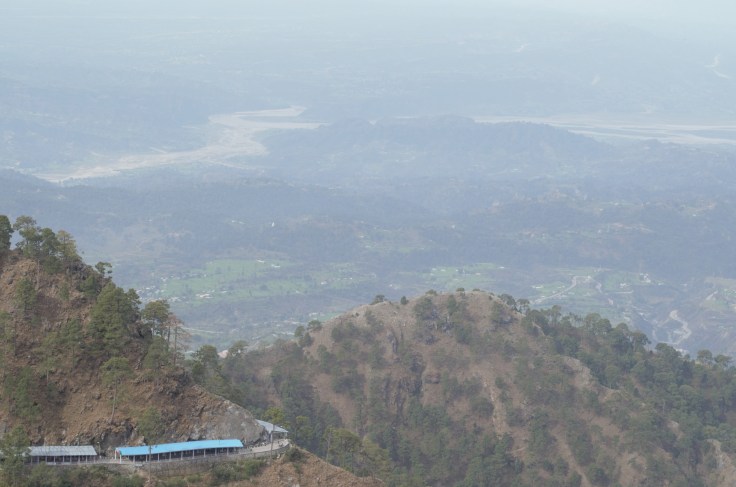
Only one family was allowed to fly by helicopter at a time. We had butterflies in our stomachs as soon as it left the tarmac. We caught our breath, steadied our heart, calmed our nerves and soaked in to enjoy our ride. Our first helicopter was completed before we realised. Thrilling experience!
My mother summed up the trip very well, “the trip down is over in 5 minutes”, thinking about the hours it took to go up.
We caught two autos and called Amitda to order pakoras and tea at the hotel.
I was overjoyed with my experience, sensed the mystery and the spirituality of the omnipotent existence in the openness of nature. The journey was beyond special.
“Thank you, God, for the opportunity”. I saluted indulging to my good fortune.
* Palanquin – A palanquin in Vaishno Devi Shrine is an open portable couch, mounted on four poles and carried at each end on the shoulders of porters The Palanquins (Palki) presently in use were built with galvanised iron pipes. Carrying the pilgrim’s weight, his/her luggage, and the palki’s weight on the trek to Vaishno Devi is an extremely strenuous task for the porters but this a mean of their living. The Palanquin is usually hired for the senior citizen and physically challenged people.
Note: Please read the links if you wish to know more about the Vaishno Devi legends.
Photo Courtesy: Self and Bapi
 callofthefar.com
Leave a Comment